
Anterior cruciate ligament injuries are among the most serious a footballer can sustain, and they are one of the reasons structured warm up programmes have become standard in academies and grassroots clubs alike.
No programme prevents ACL injuries. Football involves cutting, landing, contact and fatigue, and some injuries happen regardless of preparation. What the evidence supports is more modest and still worth having: well designed neuromuscular warm up programmes are associated with lower injury rates in football, and they are simple enough for any club to run. This article explains the idea and points to the primary sources. It is general information, not medical advice, and any programme should be supervised by a qualified coach or clinician, particularly for young players.
Key takeaways
Structured neuromuscular warm ups are associated with reduced injury rates in football, but nothing eliminates risk. The FIFA 11+ style warm up is the most widely studied approach and is designed to replace an ordinary warm up. Consistency matters more than intensity, and programmes only help when they are done regularly. Landing, deceleration and change of direction quality are the movements most often coached. If a knee gives way, swells rapidly, or cannot take weight, stop and seek medical assessment the same day.
What the ACL does and how injuries typically occur
The anterior cruciate ligament sits inside the knee and helps control forward movement and rotation of the shin relative to the thigh. In football, many ACL injuries occur without contact, during rapid deceleration, cutting, or landing awkwardly. Others involve contact or an unlucky collision.
Because a share of these injuries are non contact, movement quality is the part that can be trained. Coaches typically work on landing softly with the knee tracking over the foot rather than collapsing inwards, decelerating under control rather than stopping stiff legged, and turning with a balanced base rather than a locked leg.
Structured warm ups and what the evidence actually says
The best known programme in football is the FIFA 11+, which grew out of research on comprehensive warm up programmes. A randomised trial published in the BMJ by Soligard and colleagues in 2008 found that a structured warm up programme reduced injuries in young female footballers, and it remains one of the reference studies for this approach.
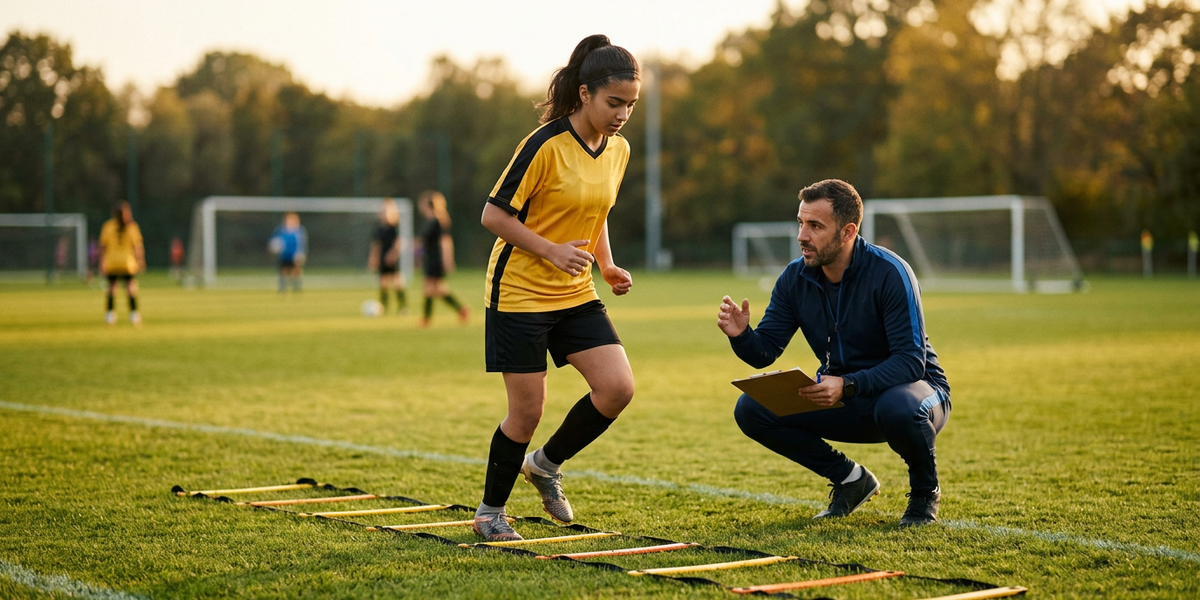
The programme runs for around twenty minutes and replaces the usual warm up. It combines slow running with active stretching and controlled partner contact, then strength, balance, plyometric and agility work such as the Nordic hamstring exercise, single leg balance, squats and jump landings, then faster running with planting and cutting.
Two caveats matter. First, results in research come from teams that ran the programme consistently across a season, so an occasional session is unlikely to do much. Second, reported effects vary between studies and populations, so the honest framing is reduced risk rather than protection.
Coaching points that make a warm up worth doing
Quality beats volume. A slow, controlled Nordic hamstring exercise with good form does more than a rushed set. Landings should be quiet and absorbed through the hip, knee and ankle. Single leg work is worth including because most football actions happen on one leg. Fatigue changes movement, so some work late in a session is useful, but not to the point where technique collapses.
For younger players, supervision is not optional. Loading, progressions and exercise selection should be appropriate for age and maturation, which is one of the themes of the IOC consensus statement on youth athletic development. A qualified coach, strength and conditioning coach, or physiotherapist should set the programme.
Recovery, sleep and load
Injury risk is not only about drills. Sudden spikes in training or match load, poor sleep and playing through fatigue all matter, and they are often easier to fix than technique. Players in busy periods with school football, club football and representative fixtures at the same time can end up with far more load than anyone is tracking. Parents and coaches comparing notes on total weekly load is a genuinely useful intervention.
If you suspect an ACL injury
Common features reported at the time include a popping sensation, the knee giving way, rapid swelling within a few hours, and being unable to continue. None of that confirms a diagnosis, and only a clinical assessment, usually with imaging, can do that.
Stop playing immediately, do not try to run it off, and arrange medical assessment. In the UK the NHS page on knee ligament surgery explains how these injuries are assessed and treated, and treatment is not always surgical. Recovery timescales vary considerably by person and by procedure, so take your timeline from your surgeon and physiotherapist rather than from anyone else.
If you are coming back from one, our guide to returning to football after a long term injury explains the criteria led approach clinicians use.
Sources and further reading
Soligard et al, comprehensive warm up programme to prevent injuries in young female footballers, BMJ 2008 NHS: knee ligament surgery NHS: sports injuries 2016 consensus statement on return to sport, British Journal of Sports Medicine IOC consensus statement on youth athletic development, British Journal of Sports Medicine 2015
This article is general information and is not medical advice. Any injury prevention programme should be supervised by a qualified coach or clinician, and any suspected knee injury should be assessed by a medical professional.