
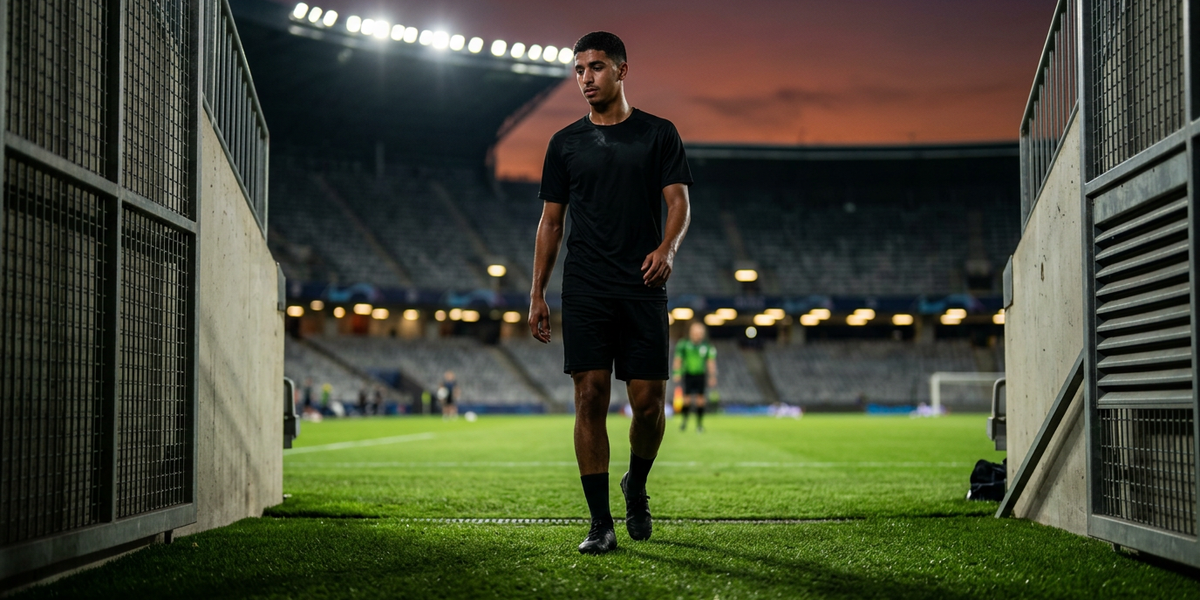
Yes, players can be scouted in football at 12, and it is one of the busiest scouting ages in the youth game. What surprises most players and parents is what scouts are actually judging. At this age they are assessing potential, not goals, assists, current size or last weekend's result. A player who scores every week for a low level team can be passed over, while a smaller player who controls the ball calmly under pressure gets watched again.
Short answer: to get scouted at 12, play regularly at the highest standard of football you can reach, be consistent rather than spectacular, and make yourself easy to find. Scouts at this age tend to assess six areas: technical ability and first touch, decision making, movement and positioning, attitude and coachability, confidence and communication, and long term physical potential rather than current size.
The rest of this guide explains each of those areas, the realistic routes into being seen, what parents should and should not do, and what happens if a scout is interested. For the wider picture across all ages and positions, read our guide to what football scouts look for.
Can you get scouted in football at 12?
You can. Age 12 sits on a real crossroads in youth football, the move from the Foundation Phase into the Youth Development Phase. Academies are refining squads at under 12 and under 13, and players are also moving from 9v9 onto the full 11v11 pitch. That combination makes it a natural point for clubs to look again at who is in the system and who has been missed.
It is also not a deadline. Plenty of players enter academies at 13, 14, 15 or later, and plenty of players in academies at 12 are released before they turn 16. Development at this age varies enormously. Two 12 year olds born eleven months apart can be years apart biologically. A good scout knows that, which is why judgements are made on trajectory rather than on who dominates a Sunday morning game today.
How does football scouting work at age 12?
Most scouting at this age is simply people watching football. Club scouts, district and county coaches, and development centre staff attend grassroots league matches, tournaments, festivals and trial days. They rarely announce themselves. A scout may watch a player three or four times over several months before saying a word, because they want to know a good performance is a standard and not a one off.
Scouts also work through networks. They talk to local coaches, teachers, tournament organisers and other scouts. A player who consistently stands out generates conversation, and that conversation brings more eyes to their games. Increasingly, recruitment departments also use digital profiles and video to shortlist players before travelling, which is why being findable online matters more than it used to.
What a scout writes down is usually a short attribute report rather than a stat line: first touch, scanning, decision speed, movement, athletic markers, reaction to mistakes. If enough of those boxes look promising, the player goes on a watch list. If the watch list performances hold up, an invitation to train or trial follows.
What do football scouts look for in 12 year olds?
Scouts are looking for signals of future ability. Here is the quick version before the detail.
| Area | What scouts may notice | How a player can develop it |
|---|---|---|
| Technical ability | Comfort on both feet, passing range, control at speed | Daily ball mastery, weak foot work, small sided games |
| First touch | Touch that sets the ball up for the next action, not just stops it | Wall passes, receiving on the half turn, touch under pressure drills |
| Decision making | Scanning before receiving, choosing the right pass quickly | Play more small sided football, watch full matches, ask why after games |
| Movement and positioning | Creating space, decoy runs, position without the ball | Study one top player in your position, work on body shape and angles |
| Attitude and work rate | Reaction to mistakes, pressing back, listening to the coach | Treat every session as the audition, take feedback without sulking |
| Confidence and communication | Wanting the ball when it is difficult, organising teammates | Practise talking in training, take responsibility in games |
| Physical potential | Balance, agility, coordination, movement quality | Coordination and strength appropriate work, rest and sleep |
Technical ability
At 12, technical skill is the first filter. This period is often called the golden age of learning because players pick up motor skills quickly. Scouts want a player who is comfortable in tight areas, can use both feet even if one is clearly dominant, and can execute under pressure rather than only in space. Passing range starts to matter as the pitch expands, and for wide players the ability to deliver on the move stands out.
Dribbling is judged on balance and change of direction rather than on how many players are beaten. Can the player stay upright, shift their hips, and come out of a tight corner with their head up? That is worth far more than a highlight run against weak opposition.
First touch and ball control
First touch is the single most commented on attribute in youth scouting reports. Scouts are not just checking whether a player controls the ball. They are watching whether the touch sets the ball into a useful position for the next action, away from pressure and into space. A player who takes a heavy touch and recovers looks different from a player who never needed the recovery.
Receiving on the half turn, controlling with the back foot and taking a bouncing ball cleanly are all things you can practise alone or with one other person. They are also the things most likely to get a scout to look up.
Decision making and football intelligence
Scanning frequency is one of the clearest modern markers. Elite players look over their shoulders far more often than average players, and scouts genuinely count head turns before a player receives the ball. Scanning shows the player is collecting information and already knows their next move.
Spatial awareness is the second part. Many 12 year olds still follow the ball around the pitch. A player who drops into a pocket between the lines, or makes a decoy run to open space for someone else, is showing an understanding that is rare at this age. Knowing when to speed the game up and when to calm it down is another sign of maturity that gets noted.
Movement and positioning
What a player does in the roughly ninety percent of the game when they do not have the ball says a great deal. Scouts watch starting positions, body shape when the ball travels, defensive recovery runs, and timing of forward runs. A striker who times a run to beat the last defender, a full back who tucks in at the right moment, a midfielder who is always available at an angle: all of that is coachable, and all of it is visible.
Attitude, coachability and work rate
Character often decides between two players of similar ability. Scouts deliberately watch what happens straight after a mistake. Does the player sprint to win the ball back, or throw their arms up? Do they keep asking for the ball after a poor pass, or hide?
Coachability matters just as much. Scouts observe how a player responds to their coach at half time and whether an instruction actually changes their behaviour in the next ten minutes. A player who visibly applies feedback is far more attractive to an academy than a talented player who argues.
Confidence and communication
Bravery at this age does not mean tackles. It means wanting the ball when the game is difficult, trying the pass again after it did not come off, and taking on a defender when the score is tight. Alongside that, scouts notice players who talk: organising, warning teammates, encouraging after a mistake. Communication is a leadership marker and it is unusual enough at 12 to stand out immediately.
Physical development, and why being bigger or faster at 12 is not everything
This is where the most damage is done to young players' confidence. Being the biggest and fastest at 12 rarely predicts anything. Scouts are trained to account for the relative age effect, where players born early in the selection year appear better simply because they are further along. Many clubs use bio banding, grouping players by biological maturity rather than birth date, precisely to see past it.
In practice, a small technical player is often rated above a bigger player who relies on power, because power is what puberty gives you later and technique is what it does not. What scouts do look at physically is movement quality: balance, agility, coordination, core strength, whether the player looks fluid rather than heavy legged.
| Scouts may notice | Scouts do not necessarily expect |
|---|---|
| A calm first touch under pressure | A long list of goals and assists |
| Head turns and scanning before receiving | Being the biggest or fastest on the pitch |
| Reaction in the ten seconds after a mistake | A polished, professional highlight reel |
| Movement and positioning off the ball | Playing one fixed specialist position |
| Consistency across several games | A single spectacular performance |
| Respectful behaviour with coaches and teammates | Representation by an agent |
How to increase your chances of being seen
You cannot control who turns up to watch. You can control the standard of football you play, how consistent you are, and how easy you are to find.
Playing for grassroots and local clubs
The single most effective step is to play at the highest standard of grassroots football you can reasonably reach. Stronger leagues and better tournaments attract more scouts and give a scout a more meaningful comparison. Being the best player in a weak division tells a scout very little; performing well against strong opposition tells them a lot.
District and county representative teams are also worth pursuing. Those squads are watched heavily, and the selection process itself gives your child experience of being assessed.
Football academies and development centres
Development centres, pre academy groups and private academies sit between grassroots and professional academies, and many have direct links to clubs. They regularly run showcase games. They can be a genuine route, but they are also a market, so check what an organisation actually delivers and who it is connected to before paying for anything.
Football trials
Open trials, ID days and pre season trials remain a real entry point, particularly at under 13, under 14 and under 15 as clubs fill squads for the next phase. Approach them with a clear head: one trial session is a small sample, and not being kept is not a verdict on the player. Our guide on how to get football trials covers finding legitimate trials and preparing for the day, and football trials in 2026 lists what is running.
Creating a football CV or player profile
Contacting clubs works far better when a coach can see the relevant information in one place rather than in a long email. An online player profile is simply that place. It typically holds age and date of birth, position and preferred foot, current club and playing history, achievements, and video, along with any other relevant football information a coach might reasonably want before replying.
It is worth being clear about what this does and does not do. A profile does not get anyone scouted, invited to a trial or signed. What it does is remove friction: when a coach, a club or a scout does want to check a player, there is something accurate and current to send them, and it can be updated after every season, growth spurt or position change.
If you are putting one together, our guide on how to make a football CV covers what to include and what to leave out, and how to contact football clubs explains how to send it without being ignored.
Highlight videos, are they useful at 12?
They are useful, with limits. No scout signs a 12 year old from a video, and they know clips are edited. What a short video can do is get someone to attend a game. Keep it brief, lead with the strongest moments, and include some unedited passages of play so the viewer can see decisions rather than only outcomes. Clear labelling matters too: which player, which colour, which position. Our highlight video tips page walks through filming and editing.
What parents should and should not do
Scouts watch the touchline. It is not a myth. Academies are assessing whether the family environment will support a child through years of setbacks, and a parent shouting instructions or arguing with officials genuinely counts against a player.
Helpful: get your child to games and training reliably, protect their sleep and recovery, let the coach coach, ask "did you enjoy it" before "did you win", and keep their profile and records accurate.
Unhelpful: coaching from the sideline, comparing your child publicly to teammates, changing clubs constantly chasing exposure, paying for expensive promises, and treating one rejection as final.
Manage expectations honestly. Very few 12 year olds go on to play professionally, and that is fine. Academy football offers excellent coaching and real life lessons regardless of the outcome, and a player who is enjoying their football plays with the freedom scouts want to see.
Common mistakes players and parents make
- Chasing goals and stats instead of developing technique and decision making.
- Playing at a level that is too easy because it feels comfortable.
- Early specialisation in one position, or dropping all other sports too soon. Multi sport athletes often retain better athletic range.
- Over training. Three or four quality sessions a week is plenty at 12, and growth spurts make overload risky.
- Sending long, generic emails to fifty clubs with no relevant detail attached.
- Treating a scout's silence as a rejection. Most watch lists are slow.
- Paying for guarantees. Nobody can guarantee a trial or a contract.
What happens if a scout is interested?
Usually it starts quietly. A scout speaks to the club coach rather than the player, asks for details, and returns to watch again. If interest develops, it moves to an invitation to train with an age group for a period, often several weeks, before anything formal is discussed. Registration rules and travel distance limits apply in most countries, so the club will check those too.
If someone approaches you directly, stay calm and polite, ask who they are and which club they represent, and ask them to speak to your child's current club coach. Legitimate scouts expect that. Take a name and a contact, do not sign anything on a touchline, and check the club's academy contact details independently.
Being invited in is a start, not a finish. Phase reviews and retain or release decisions at under 14 and under 16 are where most of the real filtering happens.
What if you have not been scouted yet?
Nothing about 12 is final. The most useful response is to focus on the things that raise your ceiling: technique, decision making, physical foundations and consistency, at the highest level of football available to you. Get into stronger environments, attend legitimate trials, keep an accurate profile and video that a coach can look at, and let the results accumulate over seasons rather than weeks.
Many players who make it were not in an academy at 12. Some were released at 14 and picked up elsewhere. Late developers routinely overtake early developers once puberty evens the physical picture out, and the technical work done now is what they overtake with.
If you want to keep going from here, read our getting scouted guide for the wider picture, and check current opportunities and trials that are open to youth players.