
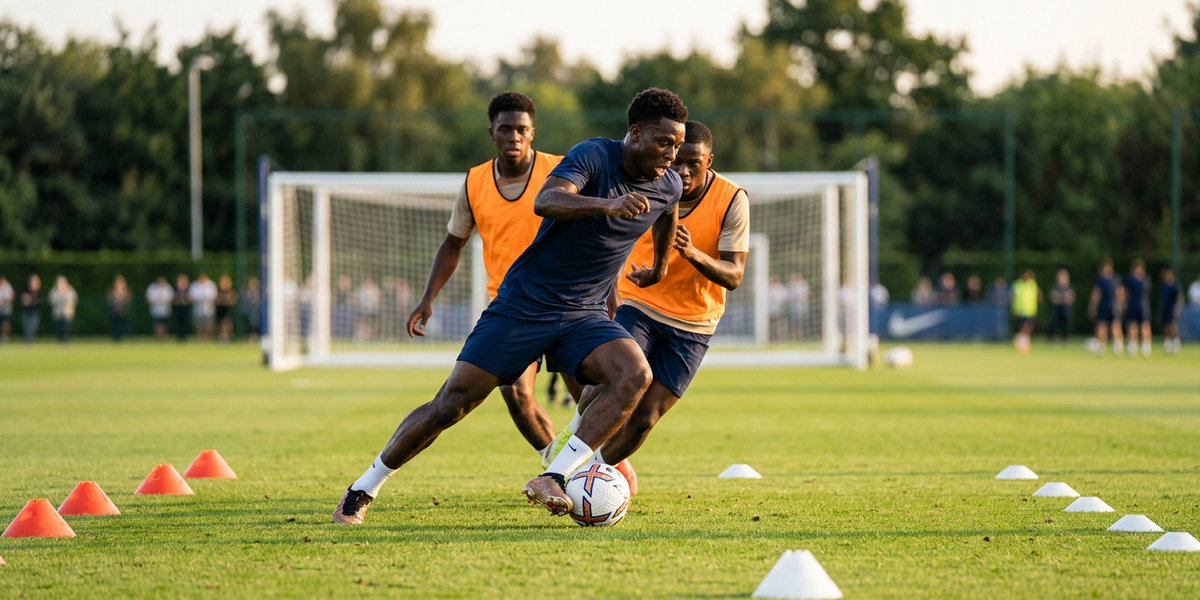
Understanding explosive power and fast twitch muscle recruitment in football
To improve explosive power for football players, you must focus on the ability of your muscles to exert maximum force in the shortest possible time. In football, this translates to your first three steps when chasing a loose ball or your ability to leap above a defender for a header. Explosiveness relies heavily on the recruitment of Type II fast twitch muscle fibers, which provide the rapid bursts of energy required for high intensity actions. Unlike endurance training, power training teaches your central nervous system to fire these fibers simultaneously, resulting in a more violent and effective movement off the mark.
True explosive power is not just about raw strength but about the rate of force development. A player might be able to squat a heavy weight, but if they cannot transition that strength into a sprint within milliseconds, they will lose 50 50 challenges. This season, modern academies at clubs like Manchester City or Ajax prioritize these explosive metrics because they often determine the outcome of transitional moments in a match. By training specifically for power, you are essentially upgrading your internal engine to deliver more torque the moment you decide to move.
Key takeaways
Focus on quality over quantity by keeping repetitions low and rest periods long to ensure maximum intensity. Master landing mechanics by keeping knees aligned and absorbing impact through the hips to prevent common ACL injuries. Combine plyometric drills with foundational strength work like squats to build a higher ceiling for power production. Consistency is vital but avoid overtraining by limiting specific power sessions to two or three times per week. Track your vertical jump and 10 yard sprint times to provide concrete data for scouts and coaches.
The science of the first step and acceleration on the pitch
Getting faster off the mark in football requires a specific understanding of horizontal force production. When you watch elite wingers like Vinicius Jr or Bukayo Saka, their first step is characterized by an aggressive forward lean and a powerful drive through the balls of their feet. This action requires the glutes, hamstrings, and calves to work in perfect synchronization. The goal of power training is to shorten the ground contact time, which is the duration your foot stays on the grass during each stride. The less time spent on the ground, the more explosive your movement becomes.
Acceleration in the first five to ten meters is arguably the most valuable physical asset in the modern game. It allows a striker to create a yard of space for a shot or a defender to recover and make a goal saving tackle. To improve this, players must train the stretch shortening cycle. This is a physiological process where the muscle is stretched rapidly before contracting, similar to how a rubber band snaps back after being pulled. Plyometric drills are the primary tool used to sharpen this cycle, making your muscles more reactive and springy.
Essential plyometric drills for football speed and agility
Plyometric drills for footballers must mimic the multidirectional nature of the sport. While linear speed is important, football is played in 360 degrees. Lateral plyometrics are essential for improving your ability to change direction and beat an opponent one on one. A staple exercise for this is the lateral bound, often called a skater jump. In this drill, you push off one leg to jump sideways as far as possible, landing softly on the other leg while maintaining balance. This builds the explosive lateral power needed for quick cuts and feints.
Another critical drill is the tuck jump, which focuses on rapid hip flexion and vertical power. From a standing position, you jump as high as possible and bring your knees toward your chest. The key here is the reactive element. As soon as your feet touch the ground, you must immediately spring back up. This teaches your body to handle high impact forces and convert them into upward momentum. For players looking to improve their match performance, these drills should be performed on grass or a firm turf surface to replicate game conditions.
The following table compares two fundamental drills used in professional academies to develop different aspects of explosiveness:
| Drill Name | Primary Focus | Football Application | | : | : | : | | Broad Jump | Horizontal Power | Sprinting and chasing long balls | | Box Jump | Vertical Power | Heading and jumping over tackles | | Pogo Jumps | Ankle Stiffness | Shortening ground contact time | | Single Leg Hops | Unilateral Stability | Balance while shooting or crossing |
How to increase vertical jump for winning aerial duels
Winning headers is not just about height but about the timing and power of your takeoff. To increase your vertical jump, you must target the posterior chain. The triple extension, where your hips, knees, and ankles all straighten at once, is the secret to a high leap. Exercises like the depth jump are particularly effective for this. A depth jump involves stepping off a small box, landing on the ground, and immediately jumping as high as possible. This drill forces your muscles to handle a heavy eccentric load before exploding upward.
It is also important to train single leg jumping. In a football match, you rarely jump with both feet planted firmly. Most aerial duels occur while you are running, requiring a powerful takeoff from one leg. Practicing single leg box jumps or hurdle hops will translate directly to your ability to win crosses in the box. Scouts often look for players who can hang in the air, and developing this explosive verticality is a great way to stand out during trials. Ensure you focus on driving your arms upward during the jump, as arm swing can contribute up to ten percent of your total vertical height.
The role of weightlifting in developing football power
There is a common misconception that weightlifting makes footballers bulky and slow. On the contrary, professional clubs use resistance training as a foundation for explosive power. You cannot have high power without a baseline of strength. For a 16 year old or 18 year old player, mastering the squat and the trap bar deadlift is essential. These movements build the raw force that plyometrics then refine into speed. A stronger muscle can produce more force, and when that force is applied quickly, it results in superior explosiveness.
However, the transition from lifting weights to playing football requires a specific approach. Instead of training like a bodybuilder, footballers should focus on explosive lifting. This involves moving the weight as fast as possible during the concentric phase, which is the upward part of the lift. Using moderate weights at high speeds is often more beneficial for power than lifting extremely heavy weights slowly. Combining a strength day with a plyometric day creates a well rounded athlete who is both strong and reactive.
Practical football strength and conditioning at home routines
You do not always need a gym to improve your explosive power. Football strength and conditioning at home can be highly effective if you utilize bodyweight plyometrics and explosive movements. If you have access to a staircase or a sturdy bench, you can perform step ups and Bulgarian split squats. To make these explosive, instead of just stepping up, you should drive through your foot and jump at the top of the movement. This builds unilateral power, which is critical since football is a game played mostly on one leg at a time.
Core stability is another home based factor that impacts explosiveness. A weak core leaks energy, meaning the power generated by your legs does not efficiently transfer through your body. Exercises like explosive mountain climbers or medicine ball slams, if you have one, help bridge this gap. Even without equipment, you can focus on isometric holds followed by explosive sprints. For example, hold a deep squat for five seconds to build tension, then immediately sprint for ten meters. This contrast training is a favorite among professional conditioners for building a faster first step.
Sample plyometric workout for teenage football players
When building a routine, the focus must stay on intensity. A sample session should begin with a thorough dynamic warmup including leg swings, high knees, and glute bridges. Once the muscles are warm, move into the power phase. A typical session for an aspiring academy player might look like this: Pogo Jumps: 3 sets of 10 reps (focus on quick ankle flicks) Broad Jumps: 3 sets of 5 reps (focus on maximum horizontal distance) Lateral Bounds: 3 sets of 6 reps per side (focus on push off power) Depth Jumps: 3 sets of 3 reps (focus on minimum ground contact time) 10 Meter Sprints: 5 reps with full recovery between each.
Recovery between sets is the most overlooked part of power training. You should rest for at least 90 seconds to two minutes between sets. If you feel tired or out of breath, you are training endurance, not power. The goal is for every single jump to be at one hundred percent effort. If your performance drops by even five percent, the session should end. Quality beats quantity every time when you are trying to rewire your nervous system for speed. This disciplined approach is what separates elite prospects from recreational players.
Landing mechanics and injury prevention for growing athletes
The biggest risk with plyometric training is not the jump, but the landing. Young players often have developing joints and growth plates that are susceptible to stress. To stay safe, you must learn to land silently. A loud thud when you hit the ground indicates that your joints are absorbing the impact rather than your muscles. You should land on the balls of your feet, quickly transitioning to the midfoot, while pushing your hips back to absorb the force. Your knees should never cave inward; they must stay aligned over your toes at all times.
Integrating balance work into your routine is also vital for injury prevention. Stable ankles and strong glutes protect the ACL, which is one of the most common injuries in football. Before you attempt high intensity depth jumps, ensure you can stick the landing of a basic broad jump without wobbling. Coaches and scouts value availability just as much as ability. If you can demonstrate that you have the physical control to land safely after an explosive header, you prove that you are a low risk, high reward prospect for their academy.
Integrating power training into your weekly football schedule
Timing your power sessions is crucial to avoid burnout and match day fatigue. You should never do a heavy plyometric session the day before a game. Ideally, your most intense power work should happen 48 to 72 hours before kick off. For example, if you play on a Sunday, a Tuesday or Wednesday session is perfect. This allows your central nervous system to recover so you feel snappy and fresh on match day. During the off season, you can increase the frequency to three times a week, but during the season, two sessions are usually enough.
It is also helpful to pair your power training with your technical work. You might perform a set of explosive jumps and then immediately go into a dribbling drill or a shooting practice. This teaches your body to maintain technical proficiency even when your heart rate is elevated and your muscles have just fired at maximum capacity. This specific type of training is highly relevant to match situations where you might have to sprint to win the ball and then immediately deliver a precise cross or a finish. In your quest to how to get a trial, showing this combination of athleticism and skill is key.
Measuring progress and tracking explosive gains for your CV
If you want to be noticed by scouts, you need to turn your physical improvements into data. Simply feeling faster is not enough; you should measure your 10 meter sprint and your vertical jump height every four to six weeks. Use a smartphone app or a simple tape measure against a wall to track your progress. When you update your build a football CV, having concrete numbers like a 55 centimeter vertical jump or a 1.7 second 10 meter split provides scouts with objective proof of your athletic potential.
Furthermore, capturing these improvements on film is essential for modern recruitment. Use these sessions to record clips of your most explosive movements. A video showing you beating a defender to a ball or outjumping a goalkeeper can be a powerful addition to your profile. By following these highlight video tips, you can ensure that the hard work you put into your plyometric drills is clearly visible to decision makers at professional clubs. Athleticism is often the first thing a scout notices, so make it a focal point of your digital presence.
Start your journey to professional football today
Improving your explosive power is one of the most effective ways to elevate your game and catch the eye of professional scouts this season. By consistently applying these plyometric drills and focusing on your first step speed, you will become a more dangerous and effective player on the pitch. Remember that physical development is a long term process that requires discipline, proper recovery, and a commitment to quality. The players who succeed are those who treat their conditioning as seriously as their ball work.
Now that you have the tools to build elite speed and power, it is time to showcase your talent to the world. A professional CV is your ticket to trials and academy opportunities globally. Do not let your hard work go unnoticed by clubs and recruiters who are looking for the next generation of explosive talent. Take the next step in your career by documenting your stats, your clips, and your progress on a platform designed to bridge the gap between ambitious players and professional football.