
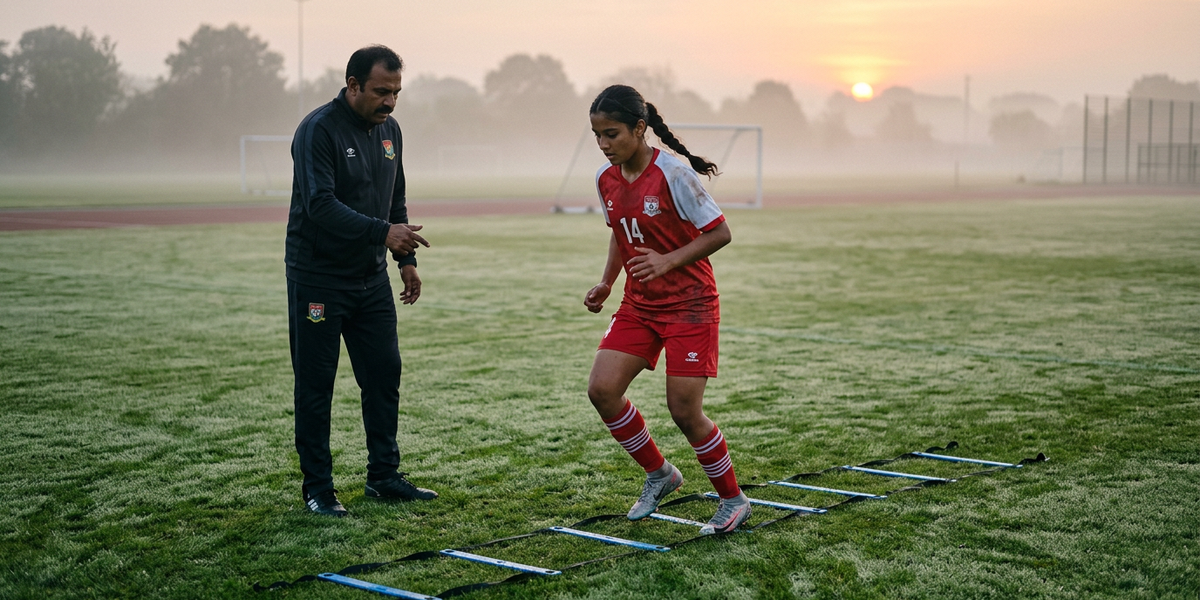
The necessity of dual footed ability in modern football
In the modern game where space is restricted and pressing is high intensity, being a one footed player is a massive tactical disadvantage. Whether you are playing in a Category One academy in England or a high level MLS Next club in the United States, scouts are looking for players who do not need to shift the ball back onto a preferred side. When you can only use one foot, you effectively cut the pitch in half for yourself. A smart defender will simply show you onto your weak side and your entire attacking threat is neutralized. Becoming a two footed player makes you unpredictable and increases your value to any coach immediately.
Think about elite players like Kevin De Bruyne or Son Heung Min who operate at the highest levels of the Premier League. Their ability to cross, pass, and shoot with either foot allows them to play in multiple positions and adapt to any match situation. For a young player aged twelve to twenty three, developing this skill is one of the quickest ways to stand out during trials. It shows a level of technical maturity that many peers lack. This article will break down the exact drills and mental shifts required to transform your weak foot into a genuine weapon this season.
The training process is not just about physical repetition but also about rewiring your brain. Most players feel awkward when using their non dominant foot because the neural pathways are not yet established. By following a structured progression from static touches to high speed match scenarios, you can eliminate this awkwardness. We will focus on practical, high repetition drills that you can perform alone or with a partner to ensure you are ready for the next level of competition.
Key takeaways
Consistent daily repetition of basic touches is more effective than one long weekly session focused on the weak foot. Focus on the positioning of your standing foot to provide the necessary balance and leverage for a clean strike. Use wall drills to maximize the number of ball contacts per minute and improve your reaction time with your non dominant foot. Gradually increase the speed and pressure of your drills to ensure your weak foot technique holds up under match conditions. Documenting your progress through video can help you identify biomechanical flaws and improve your confidence.
Understanding the biomechanics of the weak foot
Before you start smashing balls against a wall, you need to understand why your weak foot feels so heavy and uncoordinated. It usually comes down to your standing foot and your center of gravity. When you use your strong foot, your weak leg acts as a stable anchor. When you switch roles, your strong leg often struggles to provide that same stability. This results in poor balance and a lack of power. Pay close attention to where you place your dominant foot when you prepare to strike the ball with your weak one. It should be firm, slightly bent at the knee, and pointing directly at your target.
Another common issue is the lack of ankle stiffness. Many players leave their weak ankle too loose when making contact, which causes the ball to bobble or lose speed. You must practice locking your ankle at the moment of impact, just as you do with your dominant foot. Whether you are using the inside for a short pass or the laces for a drive, that rigidity is what transfers energy from your leg into the ball. Watch slow motion clips of professional players to see how their non dominant foot interacts with the ball compared to yours.
Balance is also maintained by your arms. Many young players keep their arms static when using their weak foot, which leads to a stiff and unnatural shooting motion. Your opposite arm should be out for balance, helping you rotate your hips through the ball. By focusing on these biomechanical details, you move away from just kicking the ball and start actually coaching your body to replicate the mechanics of your strong side. This foundational work is essential before moving into more complex drills.
Phase one: Building the foundation with wall drills
The humble brick wall is the best coach you will ever have for improving your weak foot. It never misses a pass and it gives you the ball back as fast as you can hit it. Start with simple inside of the foot passes from about three to five yards away. Your goal is to hit the same spot on the wall fifty times without stopping. Do not worry about power yet. Focus on the strike being clean and the ball staying on the ground. This drill builds the muscle memory required for basic ball control and short distribution.
Once you are comfortable with rhythmic passing, move on to the two touch wall drill. Receive the ball with the inside of your weak foot, take a prep touch across your body, and pass it back with the same foot. This teaches you how to manipulate the ball into space using only your non dominant side. In a real match, your first touch is what sets up the second action. If your first touch with your weak foot is poor, the subsequent pass or shot will fail regardless of your technique. Aim for three sets of fifty reps daily to see rapid improvement.
Advanced wall work involves using the laces and the outside of the foot. Stand further back, perhaps ten yards, and focus on striking the ball firmly against the wall with your laces. Your ankle must be locked and your toes pointed down. The rebound will come back with more pace, forcing you to use your weak foot to cushion the ball on the first touch. High repetition in a short space of time is the secret to technical development. Ten minutes of focused wall work everyday is better than two hours once a week.
Phase two: Dynamic movement and change of direction
A player who can only use their weak foot while standing still is not useful in a game. Phase two focuses on incorporating your weak foot into your dribbling and movement. Set up a basic slalom using six cones spaced one yard apart. You must navigate the cones using only your weak foot. Use the inside and outside of the foot to guide the ball through the gaps. Focus on keeping the ball close to your body. If the ball gets too far away, you lose the ability to protect it from a defender.
After mastering the slalom, introduce the box drill. Create a four by four yard square with cones. Dribble in a circle inside the square using only your weak foot. Every few seconds, change direction sharply using an inside or outside hook. This forces your weak leg to become the primary driver of your movement and balance. It also trains your brain to accept the weak foot as a reliable tool for escaping tight spaces. In the modern game, being able to turn away from a marker using your non dominant foot is a high level skill.
Incorporate these movements into your warm up before every team training session. Most players will use their strong foot for the entire warm up without thinking. By consciously choosing to use only your weak foot during technical warm ups, you gain an extra fifteen to twenty minutes of development time every day. This consistency is how you eventually reach a point where you do not even have to think about which foot you are using. The goal is to make the use of your weak foot an unconscious reaction to the ball.
Phase three: Range and power in passing and shooting
Once you have mastered short passes and close control, you must address long range distribution and finishing. Many players find that their weak foot is fine for five yard passes but fails when they need to switch play or strike a goal bound shot. Start by finding a partner or a large fence and practice long balls from twenty yards. Focus on the follow through. Your weak leg should swing through the ball toward your target, rather than stopping abruptly at contact. This follow through is what generates accuracy and distance.
For shooting, start with a stationary ball at the edge of the eighteen yard box. Place your standing foot properly and focus on hitting the center of the ball with your laces. Do not try to scream it into the top corner immediately. Aim for the bottom corners and focus on the sound of the strike. A clean strike makes a distinct thud. As you gain confidence, start dribbling toward the goal and shooting while in motion. This adds the element of timing and coordination that you will face during a match at an academy or college level.
A great drill for power is the power rebounder drill. If you have access to a rebound net, stand ten yards away and strike the ball as hard as you can with your weak foot laces. The challenge is to control the powerful rebound with your weak foot and immediately set yourself for another shot. This builds the strength in your lower leg and improves your reaction speed. Remember that power comes from technique and timing rather than raw muscular force. Stay relaxed through the shoulders and let your leg do the work.
The cognitive shift: Thinking in two feet during matches
The biggest hurdle to becoming two footed is often mental. Players are afraid of making a mistake in a game, so they revert to their strong foot even when it is the wrong tactical choice. To overcome this, you must give yourself permission to fail during training and low stakes matches. Tell yourself that for the first twenty minutes of a scrimmage, you will only use your weak foot for passing. By forcing this constraint, you break the mental habit of always looking for your dominant side.
Visualizing your success is also a powerful tool. Before a match, spend five minutes imagining yourself making a perfect cross or scoring a goal with your weak foot. See the mechanics in your mind the placement of the standing foot, the locked ankle, and the ball hitting the net. This mental rehearsal makes the actual movement feel more familiar when the opportunity arises on the pitch. When you finally execute a weak foot pass in a game, it provides a massive boost to your confidence, making the next one even easier.
Scouts look for players who make the right decision regardless of the foot required. If the open lane is on your left but you try to force a pass with your right, you are signaling to the scout that you are limited. Overcoming this mental block is what separates average players from those who can play in professional academies. You can research some highlight video tips to see how documenting these moments of two footedness can actually help you get scouted. Showcasing that you can operate on both sides of the ball is a major selling point for your future career.
Drills for youth wingers and attackers
If you play as a winger or forward, your weak foot is primarily a tool for creating goals. A winger who can only cross with one foot is a dream for a defender to mark. To combat this, set up a crossing drill where you dribble down the wing, cut inside, and then immediately back outside onto your weak foot for a cross. This movement mimics a real game situation where you have beaten your man and need to deliver a quality ball into the box. Focus on the whip and height of the cross.
For attackers, the turn and shoot drill is vital. Receive the ball with your back to goal, turn onto your weak side, and take a shot within two touches. This forces you to be efficient with your movement. In a crowded penalty area, you rarely have time to adjust to your strong foot. Being able to snap a shot away with your weak foot will easily gain you an extra five to ten goals per season. Practice this from different angles to ensure you are comfortable across the entire width of the eighteen yard box.
Another excellent drill is the 1v1 weak foot challenge. Practice one on one situations against a teammate where you are only allowed to score or cross with your weak foot. This adds the pressure of a real opponent and forces you to find ways to use your non dominant side under duress. This is where you will truly see if your training is paying off. If you can beat a defender and deliver a ball with your weak foot, you have officially become a much more dangerous player. Check out our guide on how to make a football CV to learn how to highlight these technical attributes to potential clubs.
Using technology and video to track your progress
In 2026, technology is more accessible than ever for young athletes. One of the best ways to improve your weak foot is to record your training sessions on your phone. Set up a tripod and film fifteen minutes of your wall work or shooting drills. When you watch the footage back, compare the movement of your strong leg to your weak leg. You will likely notice small differences, such as the angle of your hips or the height of your backswing. Seeing these flaws makes them much easier to correct in your next session.
You can also use apps that track ball touches or shot velocity. While not strictly necessary, they provide objective data that proves you are getting better. Seeing your shooting speed increase from thirty miles per hour to forty miles per hour on your weak foot is a huge motivator. Data does not lie, and in the world of professional scouting, being able to provide metrics on your technical development can be very impressive. It shows an analytical approach to your own game that many coaches find attractive.
Don't just film your successes; film the mistakes too. Analyzing why a ball went wide or why you lost your balance provides more insight than a clip of a perfect goal. This self coaching habit is common among top professionals. By the time you reach an elite academy level, you will be expected to understand your own biomechanics and technical profile. Starting this process now gives you a significant head start on your competition.
Action plan for your weekly training schedule
To see real results, you need a structured plan. You cannot just kick a ball around aimlessly and expect to improve. Aim for four days a week of dedicated weak foot training. On Mondays and Wednesdays, focus on foundation and wall work. On Tuesdays and Thursdays, focus on dynamic dribbling and shooting. Friday should be a rest day or light technical work, and the weekend is for applying what you have learned in your matches. Consistency over a long period is what builds elite skill.
A typical thirty minute session should look like this: five minutes of weak foot only juggling to feel the ball, ten minutes of wall passing (inside and laces), ten minutes of cone dribbling and directional changes, and five minutes of finishing or long passing. This ensures you are hitting all aspects of technical development. If you are also training with a team, try to use your weak foot for every activity during the warm up and transition periods. Every touch counts toward your goal of becoming two footed.
Keep a training log to track your repetitions and how you felt. Over time, you will see the notes change from "felt awkward and slow" to "scored three goals in training with my left foot." This documented journey is not only great for your confidence but can also be used as proof of your work ethic when talking to scouts or coaches. They want to see players who are dedicated to self improvement. Professionalism starts with your training habits long before you ever sign a contract.
How showing two footed ability attracts professional scouts
When a scout watches a game, they are looking for "pro habits." One of the most obvious pro habits is the ability to use both feet naturally. If a scout sees a midfielder receive a pass on their weak side and immediately play a crisp, first time ball with that same foot into a forward's path, it sends a clear signal. It tells the scout that the player has spent hours on the training pitch refining their technique. This level of dedication is often a better indicator of future success than raw physical talent.
Furthermore, being two footed makes you much more versatile. A coach is more likely to sign a player who can cover both fullback positions or play anywhere across the front three. In the high stakes world of professional football, versatility equals value. If a club is looking to fill a specific roster spot and you can demonstrate proficiency with both feet, you immediately jump to the top of the list. It makes the coach's job easier and gives them more tactical options during a match.
Ultimately, your goal is to make your weak foot so reliable that it is no longer a "weak" foot, but simply your "other" foot. This level of technical excellence is rare and highly sought after in regions like the US, UK, and Europe. By following the drills and principles outlined in this guide, you are putting yourself in the best possible position to succeed. Do not wait for a coach to tell you to work on it. Take the initiative now and transform your game for the 2026 season and beyond.
Take the next step in your football career with FootballersCV
Becoming a two footed player is a major milestone in your development, but skills alone are not enough if the right people do not see them. In the competitive landscape of 2026, you need a professional platform to showcase your technical ability, match footage, and career statistics. FootballersCV provides the tools you need to build a comprehensive player profile that is accessible to scouts, academies, and clubs worldwide. Whether you are looking for a trial in Europe or a college scholarship in the USA, our platform bridges the gap between talent and opportunity.
Don't let your hard work on the training pitch go unnoticed. By creating a profile, you can upload your highlight reels showing off your new two footed skills and connect directly with football professionals. It is time to take control of your footballing future and give yourself the exposure you deserve. Join thousands of ambitious players who are already using FootballersCV to move to the next level of the game. Create your free profile today.