
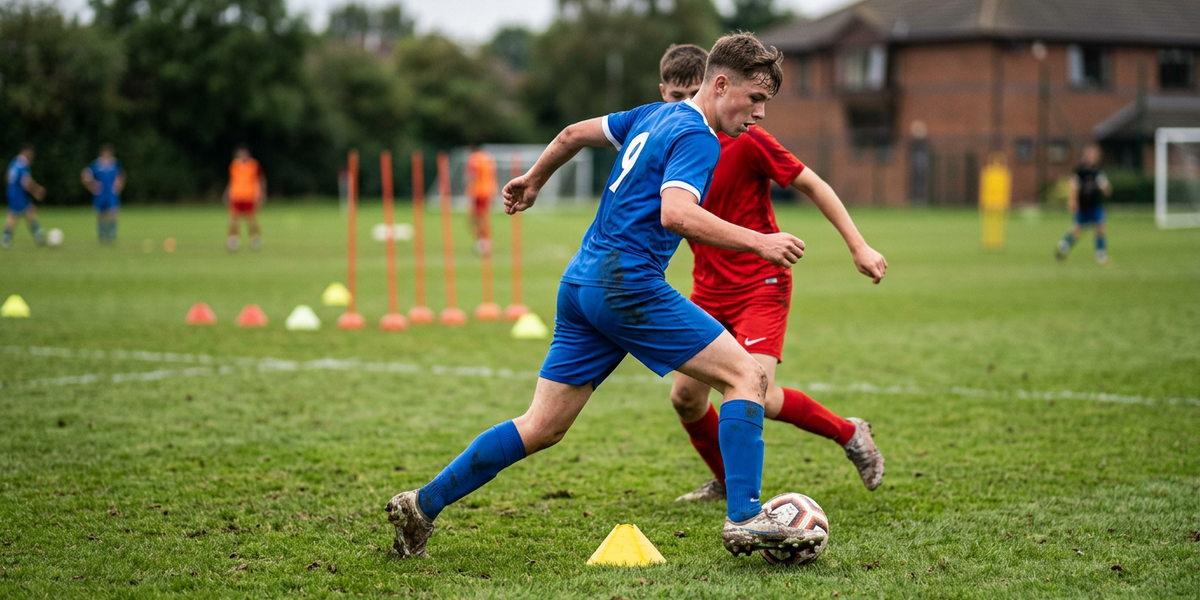
How to play as a false 9 explained for modern players
Learning how to play as a false 9 requires a blend of tactical intelligence and technical precision. At its core, a false 9 is a center forward who abandons the traditional post at the top of the formation to drop into deeper areas of the pitch. By doing so, you occupy the space between the opposition midfield and defense, often referred to as the hole. This movement forces defenders into a difficult choice: they must either follow you and leave a gap in their defensive line or stay in position and allow you time and space to dictate the play.
The primary objective of this role is to create numerical superiority in midfield. When you drop deep, you effectively become an extra playmaker, making it harder for the opposing team to track runners or block passing lanes. This is not about avoiding the physical battle in the box but rather about choosing when and where that battle takes place. For a young player in 2026, mastering this role can make you an indispensable asset for coaches who value fluid, attacking football.
Key takeaways
The false 9 role combines the responsibilities of a striker and an attacking midfielder to disrupt the defensive structure. Success depends on your ability to scan the pitch and identify pockets of space between the lines of the opposition. Effective communication with wingers is essential to ensure that vacated central space is exploited by runners. Technical excellence in first touch and short passing is mandatory to survive the congestion of the midfield area. Physicality remains important as you must be able to protect the ball when defenders follow you into deep positions.
Where does a false 9 stand on the pitch during a match
Understanding your positioning is the first step toward mastering this role. While a traditional number 9 might spend eighty percent of the match inside the width of the penalty area, a false 9 operates in a much wider zone. You will often start in a central forward position to pin the center backs, but as your team builds possession, you shift your starting point. You should look to hover around thirty yards from the goal, situated between the defensive and midfield lines of the opponent.
Your positioning must be dynamic rather than static. If you stand still, you are easy to mark. Instead, you should move horizontally across the pitch, drifting toward the half spaces or dropping toward the center circle. This movement makes it difficult for a specific defender to take responsibility for you. In modern football, academies look for players who can find these windows of space where they are neither a midfielder nor a striker. This ambiguity is your greatest weapon.
When should I drop into midfield to influence the game
Timing is everything when you decide to drop deep. If you drop too early, you leave your team without a focal point in the attack, allowing the defenders to push up and compress the game. The best time to drop is when your central midfielders have secured the ball and are looking for a vertical passing option. By moving toward the ball at the moment the passer looks up, you provide a clear lane that bypasses the opposition midfield press.
You must also consider the positioning of your teammates. If your wingers are hugging the touchline, dropping deep is highly effective because it creates a massive gap in the center of the pitch. However, if your team is already crowded in the middle, staying higher to provide depth might be the smarter tactical choice. You must constantly ask yourself if your presence in midfield is actually helping to progress the ball or if you are simply getting in the way of your own playmakers.
How to drag center backs out of position effectively
The ultimate goal of the false 9 movement is to manipulate the opposition back line. When you drop deep, you are essentially baiting the center back to follow you. If the defender is aggressive and stays close to you, they leave a hole where they used to stand. This is the perfect moment for a winger or an attacking midfielder to make a diagonal run into that vacated space. You must be aware of this potential and be ready to play a first time ball into the path of the runner.
To make this work, you often need to start by playing like a traditional striker. Engage the defender, lean into them, and make them believe you want a physical battle. Then, suddenly dart into the midfield pocket. This change of pace and direction is what catches defenders off guard. If you manage to drag a defender fifteen yards out of their zone, you have successfully compromised the entire defensive structure of the opponent, regardless of whether you receive the ball or not.
Technical skills every false 9 must master this season
To survive in the tight spaces of the midfield, your first touch must be flawless. You will often receive the ball with your back to the goal while under heavy pressure from behind. Being able to cushion the ball and keep it close to your body is the difference between starting an attack and losing possession in a dangerous area. You should practice receiving the ball on both feet and using your body to shield the leather from the reaching legs of a defender.
Passing range is another critical component. A false 9 is a facilitator. You need to be comfortable playing short, sharp wall passes as well as long, switching balls to the opposite flank. Your vision must be expansive. Before the ball even reaches you, you should have scanned the pitch to know where every teammate and opponent is located. This mental processing speed is what separates elite false 9s from average strikers who are simply dropping deep because they cannot get into the game.
Professional examples of the best false 9 players to watch
While Lionel Messi is the most famous example of this role, modern players offer different interpretations that are worth studying. Look at how Roberto Firmino functioned at Liverpool, where his selfless movement allowed wingers like Salah to become the primary goalscorers. Firmino was a master of the defensive side of the role, pressing from the front while still being a creative hub in the final third. His ability to link play was fundamental to their tactical success.
Another great example to watch in 2026 is Harry Kane, who evolved from a pure finisher into a deep lying forward. He often drops into the number 10 position to spray passes out wide, showcasing how a physically large player can still excel in a creative role. Studying these players will help you understand that the false 9 is not a one size fits all position. You can adapt the role based on your own physical and technical strengths, whether you are a diminutive dribbler or a powerful passer.
How to communicate with your wingers for maximum impact
Success as a false 9 is a collaborative effort. You must have a clear understanding with your wingers regarding who occupies which space. Before the match, discuss triggers with them. For example, tell your left winger that when you drop toward the right half space, they should immediately look to cut inside and occupy the central forward position. This rotation ensures that the team never lacks a presence in the penalty box.
During the game, use verbal cues and hand signals to direct play. If you see a gap opening up behind a defender who is tracking you, point to it. Effective communication reduces the confusion that often arises when a team plays without a fixed striker. In your highlight videos, scouts look for these moments of leadership and tactical coordination. Showing that you can organize an attack through movement and communication is a high level trait that academies highly value.
What to do if the defender stays back in the penalty area
Sometimes you will face a disciplined defense where the center backs refuse to be baited into midfield. If the defender stays back, you must not get frustrated. Instead, enjoy the freedom this gives you. If nobody is marking you in the midfield pocket, you have time to turn, face the goal, and pick a pass. In this scenario, you become the primary playmaker, and the opposition is essentially playing with one less man in the middle of the park.
If they continue to sit deep, you can also use that space to build up momentum. Take a few touches to drive at the defensive line. By carrying the ball at pace toward the center backs, you eventually force them to commit. Once they step out to challenge you, the space behind them opens up again. The key is to remain patient and recognize that if they do not follow you, you are still providing immense value by helping your team maintain possession and control the rhythm of the match.
How to demonstrate false 9 intelligence to scouts and academies
When building your profile and planning your highlight reels, it is important to show more than just goals. Scouts from top clubs in the UK, Europe, and the MLS are looking for players with a high football IQ. Include clips where your movement creates a goal for a teammate, even if you did not touch the ball. Highlight your scanning habits by showing footage where you look over your shoulder several times before receiving a pass in a tight area.
When you learn how to make a football CV, ensure you describe your role clearly. Mention your ability to play between the lines and your contribution to the build up phase. If you have data on your passing accuracy in the final third or your successful ball progressions, include those metrics. Being a false 9 is about being a complete footballer, and your resume should reflect that versatility and intelligence. Use your performance to prove that you can solve tactical problems on the pitch without needing constant instruction from the sidelines.