
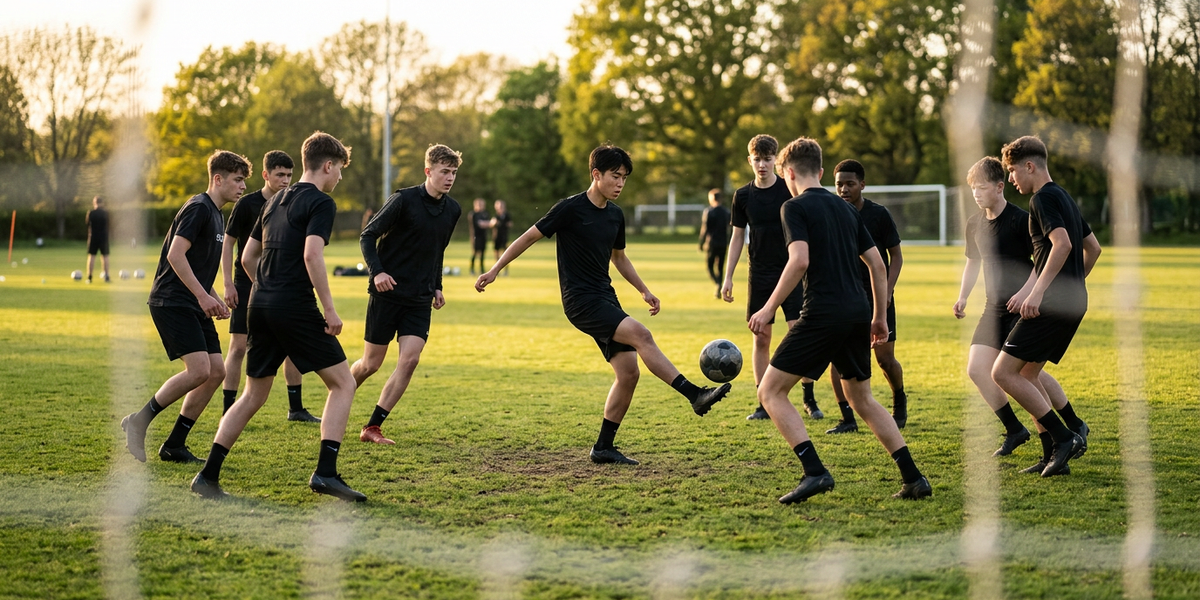
Definition of the roaming playmaker role in football
To play as a roaming playmaker in football means acting as the creative engine of the team by moving across all vertical zones to find and exploit space. Unlike a static midfielder who remains in a fixed area, the roaming playmaker is a highly mobile bridge between the defense and the attack. This player is responsible for collecting the ball from the back, progressing it through the middle thirds, and eventually arriving in the final third to deliver the decisive pass or shot. Mastery of this role requires a blend of technical excellence, elite stamina, and the mental maturity to understand the rhythm of the game.
A roaming playmaker is essentially the heartbeat of a tactical system. They provide an ever present passing option for teammates who are under pressure. By constantly moving into pockets of space, they force the opposition to make difficult decisions about who should mark them. If a defender follows the roamer out of position, it creates a gap for a striker to exploit. If the defense stays deep, the playmaker has the time and space to pick a defense splitting pass. It is a role defined by freedom but governed by high tactical intelligence.
Key takeaways
A roaming playmaker must possess elite cardiovascular endurance to cover ground from box to box for 90 minutes. Success in this role depends on constant scanning of the pitch to identify passing lanes and defensive gaps before the ball arrives. Balancing offensive freedom with defensive responsibility is critical to ensure the team is not vulnerable on the counter attack. Developing a high football IQ through video analysis helps players understand when to drop deep and when to push forward. Technical skills like one touch passing and ball retention under pressure are non negotiable for this specific position.
What position does a roaming playmaker play exactly
In most modern formations like the 4 3 3 or the 4 2 3 1, the roaming playmaker typically occupies the number 8 position. They are part of a midfield trio where they have the license to drift laterally and vertically. In a 4 3 3 system, you will often see them operating in the half spaces between the wing and the center of the pitch. This allows them to link up with the full back and the winger while still being able to drop back next to the defensive midfielder to help build the play from the goalkeeper.
The roaming playmaker is not restricted to the center circle. You might find them dropping between the center backs to create a three man build up or overlapping the winger to deliver a cross from the corner of the penalty area. This versatility is what makes them so dangerous. While they are officially a central midfielder, their influence extends across the entire width of the pitch. Scouts look for players who can adapt their positioning based on the flow of the game rather than those who wait for the ball to come to them.
Roaming playmaker vs deep lying playmaker differences
It is easy to confuse the roaming playmaker with the deep lying playmaker, but their tactical functions are distinct. A deep lying playmaker like Andrea Pirlo or Jorginho usually sits in a pocket of space just in front of the defense. Their primary goal is to dictate the tempo with long range passing and lateral switches. They rarely venture into the opposing penalty box. Their game is about control and structure from a fixed, deeper starting point. They are the architects who stay at the base of the construction.
In contrast, the roaming playmaker is much more dynamic and vertically oriented. While they can drop deep to start a move, they are expected to follow that move all the way into the attacking third. If you look at players like Luka Modric or Mateo Kovacic, you see them carrying the ball through midfield and engaging in quick combinations near the opponent goal. The roaming playmaker takes more risks and covers significantly more distance than a traditional deep lying playmaker who relies on positioning over running.
How to find space in a crowded midfield during a match
Finding space in a congested midfield is the ultimate test of a playmaker. The most effective technique is the blind side movement. Instead of standing still, you should move into the peripheral vision of the opposing midfielders. By positioning yourself just behind their shoulder, you force them to turn their head. The moment they look away or move toward the ball, you sprint into the vacated space. This split second of invisibility allows you to receive the ball with enough time to turn and look forward.
Another vital strategy for finding space is understanding the concept of the half space. These are the vertical corridors between the center of the pitch and the wings. Most defensive structures are designed to protect the middle and the flanks, often leaving the corridors in between poorly guarded. By drifting into these half spaces, you draw central defenders out of their comfort zone. If they stay put, you have a clear angle to slide a pass through the defensive line. Always stay on the move and never occupy the same horizontal line as your teammate.
When should I leave my defensive position to join the attack
Deciding when to leave your defensive station is a matter of risk assessment. You should only commit to a forward run when your team has established controlled possession in the middle or final third. If the ball is still bouncing around or the possession is unstable, leaving your zone can be disastrous. A roaming playmaker must always glance back to see if a teammate, such as a defensive midfielder or a full back, has tucked in to cover the space they are about to leave. This is known as defensive balance.
The trigger for a forward burst should be a clear numerical advantage or a transition moment. For example, if your team wins the ball back and the opposition is disorganized, that is the time to sprint forward to create a 3 on 2 or a 4 on 3 situation. However, if the game is tight and the opponent is dangerous on the break, you might choose to stay deeper to act as a safety valve. Being a roaming playmaker does not mean roaming all the time. It means roaming with a specific purpose that benefits the team structure.
Best stats to improve for creative midfielders this season
If you want to get noticed by scouts in 2026, you need to focus on specific data points that prove your impact as a playmaker. Pass completion rate is important, but progressive passing distance is even more critical. Scouts want to see that you are not just playing safe sideways balls but are actually moving the team closer to the goal. Aim for a high percentage of passes into the final third and into the penalty area. These stats indicate that your roaming movement is resulting in genuine attacking threat.
Beyond passing, you should track your progressive carries and successful dribbles. A roaming playmaker who can beat a man in midfield and then release a pass is a nightmare for defenders. Defensively, look at your interceptions and ball recoveries. High numbers here show that you have the work rate to contribute when the team does not have the ball. Improving your stats requires a focus on efficiency. Use your knowledge of <a>how to make a football CV</a> to highlight these specific metrics to potential clubs and academies.
Drills to improve scanning and spatial awareness for playmakers
To excel as a roaming playmaker, you must train your brain to see what others miss. A simple but effective drill is the color cone scan. Have a partner stand behind you with different colored cones or cards. As you receive a pass from a third player, your partner holds up a color. You must shout the color before you touch the ball. This forces you to take your eyes off the ball and look over your shoulder, mimicking the act of scanning for defenders in a real match. Over time, this becomes a subconscious habit.
Another great exercise is the 4 v 2 rondo with a twist. In a small grid, the four players on the outside must complete ten passes while the two in the middle try to win it. However, one of the outside players is designated as the roamer and must move across the center of the grid to receive the ball on the opposite side. This teaches you how to time your movement through a crowded area and how to body orient yourself to play the ball out of pressure instantly. Consistency in these drills will make your spatial awareness elite.
Physical demands and stamina requirements for the role
The roaming playmaker role is perhaps the most physically demanding position on the field. In a typical professional match, these players cover between 11 and 13 kilometers. A large portion of this distance is covered at a moderate intensity, but the role also requires frequent high speed bursts to exploit gaps. You need a massive aerobic base to ensure that your technical quality does not drop in the final fifteen minutes of the game. Fatigue is the biggest enemy of creativity and decision making.
To prepare for these demands, your training should include interval runs and match specific endurance work. Instead of just long slow jogs, perform 800 meter sprints with short rest periods to simulate the repeated sprints required in midfield. Strength training is also vital. You need core stability and lower body strength to hold off physical opponents while you are looking for a pass. If you cannot withstand the physical pressure of a league like the MLS or the English Championship, your tactical intelligence will be neutralized by more athletic players.
How parents can help young players develop tactical IQ
Parents play a crucial role in developing a young playmakers mental game. Instead of just watching the ball during matches, encourage your child to watch the professional players who play their position. Use a tactical lens. Ask questions like where is the midfielder looking before they get the ball or why did they move to the right when the ball was on the left. This kind of active analysis helps children internalize the movements and decisions of elite players. Watching full matches rather than just highlights is key for understanding positioning.
Recording matches and reviewing them together is another powerful tool. You do not need professional equipment. A simple tripod and a phone can capture enough footage for a post match review. Focus on the moments where the player found space and the moments where they were trapped. This visual feedback is often more effective than verbal coaching. It allows the player to see the pitch from a birds eye view, which is essential for someone aspiring to be a roaming playmaker. Check out our <a>highlight video tips</a> to learn how to present this footage effectively.
Creating a professional profile to showcase your tactical skills
Once you have mastered the tactical nuances of the roaming playmaker role, you need a platform to display your talent. Clubs and scouts in 2026 are looking for players who understand the modern game. When you are looking for <a>how to get a trial</a>, having a documented history of your matches, stats, and tactical understanding is your greatest asset. Do not rely on word of mouth alone. A professional presentation of your skills can be the difference between being ignored and getting an invitation to an academy.
Your CV should highlight your versatility and your specific contributions to the team. Mention your ability to play across different midfield roles and include data on your passing accuracy and work rate. Use video clips that specifically show you scanning the pitch and moving into space, not just your goals and assists. This proves to a scout that you have the football IQ required for high level competition. It is about building a brand as a smart, reliable, and technically gifted midfield operator.