
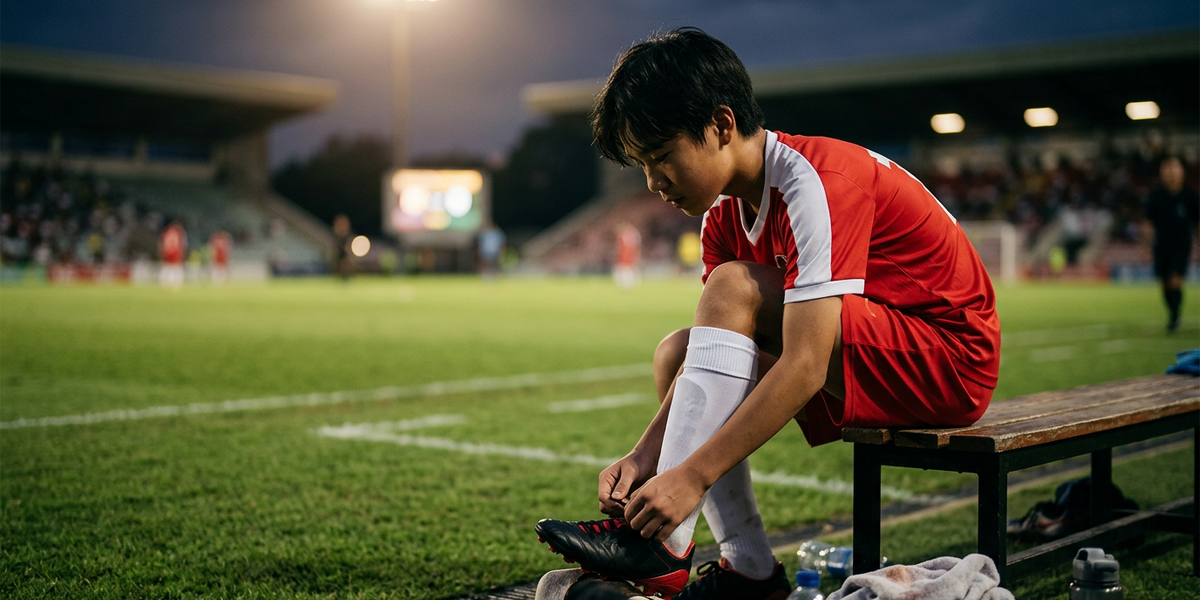
Most young players go through spells where football feels heavy. Late nights, exams, long travel to training and a run of poor results will do that. Ordinary tiredness usually lifts after a lighter week, a proper break and some sleep.
Persistent distress is different. When low mood, anxiety, dread before training or exhaustion lasts for weeks, or starts affecting school, sleep, eating or friendships, that is a health matter and it needs a trusted adult and a qualified professional, not a tougher mentality.
This article is written for players and parents. It is general information, not medical advice, and nothing here is a diagnosis.
If you need help now
If a player is in crisis or at risk of harming themselves, get urgent help. In the UK you can call 999 in an emergency, or call 111 and select the mental health option. Samaritans are available at any hour on 116 123, and Childline supports under nineteens on 0800 1111. Outside the UK, use your local emergency number and health service.
Key takeaways
Tiredness that lifts with rest is normal, and distress that persists for weeks is not something to push through. Parents, guardians and coaches should be told early, and a GP is the right next step when symptoms persist. Rest is part of the answer, but it is not the whole answer when mood, sleep or appetite are affected. There is no fixed number of weeks that resets a player, because recovery is individual. Speaking up early tends to be easier than doing it after something breaks down.
The difference between fatigue and something more
Ordinary fatigue tends to be tied to a cause you can name, such as a heavy fixture block or a bad week of sleep. It improves with a lighter week and it does not follow the player into the rest of their life.
Signs that deserve more attention include low mood or irritability most days for two weeks or more, losing interest in things the player normally enjoys away from football, sleep that is disturbed even when the schedule allows rest, appetite changes, withdrawing from friends, anxiety before ordinary sessions, or feeling hopeless about progress. The NHS pages on mental health describe these patterns in plain language and are a good shared reference for a family conversation.
The IOC consensus statement on mental health in elite athletes makes a similar point for sport specifically. Athletes experience mental health symptoms much like everyone else, and sport culture can delay them asking for help.
Why young footballers are exposed to this
Youth football stacks several pressures at once. Training load rises in the same years as exams. Selection is public and often feels final. Social media makes comparison constant. Identity narrows if a player is known only as a footballer, so a bad run can feel like a verdict on the whole person. Travel and early starts erode sleep, and sleep loss makes everything else feel worse.
None of these are character flaws. They are load, and load can be managed once someone knows about it.
Talking to a trusted adult
The first conversation is usually the hardest and usually the most useful. For a player, a workable opening is simple and factual: "I have not been enjoying football for a few weeks and I am tired all the time. Can we talk about it?" Pick a parent, guardian, a coach you trust, a teacher, or a club welfare officer.
For parents, ask open questions and resist the urge to fix it immediately. Listen for how long it has been going on and whether it shows up outside football. If it does, or if it has lasted weeks, book a GP appointment. Clubs with academy status usually have a designated safeguarding or welfare lead, and it is reasonable to involve them.
Practical things that help alongside professional support
Protect sleep first, because it is the single change with the widest effect. Agree a realistic training and school schedule with the coach rather than quietly dropping sessions. Keep one activity that has nothing to do with football. Reduce the amount of the day spent scrolling comparison content. Where load is genuinely too high, a coach can adjust it, and asking for that is a normal part of long term development rather than a sign of weakness.
Rest helps, but if mood, sleep or appetite are affected, rest alone is not the plan. Involve a GP.
Coming back
A return to full training usually works better when it is gradual and when the player has a say in the pace. There is no standard timetable, and anyone quoting one does not know the individual. Progress often looks like enjoying a session again before performance returns, so judge it on how the player feels rather than only on output.
When the player is ready to look forward again, focusing on something concrete can help. Keeping a profile updated and planning realistic next steps with our guide to getting football trials or the football CV builder gives the season a purpose that is not tied to one selection decision.
Sources and further reading
NHS: mental health NHS: mental health services and how to access them Samaritans Childline Mental health in elite athletes: IOC consensus statement, British Journal of Sports Medicine 2019 IOC consensus statement on youth athletic development, British Journal of Sports Medicine 2015
This article is general information and is not medical advice or a diagnosis. If you are worried about a young player's mental health, speak to a GP or another qualified health professional.