
The Reality of Individual Training in 2026
Being without a team in 2026 does not mean your development has to stop. Whether you are a free agent between clubs, a college student looking for a roster spot in the USA, or a young player in Europe waiting for your next academy trial, solo training is a secret weapon. Many players view team absence as a setback. In reality, it is a rare opportunity to focus entirely on your specific technical flaws. In a team environment, sessions are designed for the collective. When you train alone in the park, the session is designed entirely for you.
Individual training allows for a level of technical repetition that is impossible in a group setting. In a standard 90 minute team session at a Category 1 academy in the UK, a player might touch the ball around 200 to 300 times. In a structured solo session, you can comfortably hit 1,000 to 1,500 touches. This volume is what builds muscle memory and allows you to execute skills under pressure during games. The modern game moves faster than ever, and your first touch must be subconscious. Solo drills provide the foundation for that level of performance.
Success this season depends on your discipline. Without a coach blowing a whistle or teammates pushing you, it is easy to drop your intensity. To make your solo sessions effective, you must replicate match conditions. This means every sprint, every pass against a wall, and every shot must be done at 100 percent speed. Walking through drills provides little benefit. This guide provides the structure you need to transform a lonely afternoon in the park into a professional grade training experience.
Key takeaways
Solo training allows for up to five times more ball touches per hour compared to traditional team practice. Walls and rebounders are essential tools for simulating passing and receiving in a game environment. A structured training plan must include technical work, physical conditioning, and mental visualization to be effective. Recording your solo sessions provides objective feedback and content for your digital football profile. Maintaining professional standards while training alone is what separates elite players from amateurs.
Mastering the Foundation: High Repetition Ball Control Drills
Ball control is the most important skill for any player regardless of their position. When practicing alone, you should focus on varied surfaces of the foot. Start with the laces, then move to the inside, outside, and the sole. A classic drill is the box shuffle. Place four cones in a small square roughly two yards apart. Spend 60 seconds moving the ball inside the square using only the soles of your feet, then switch to only the outsides. The goal is to keep the ball moving constantly while keeping your head up.
Juggling is often dismissed as a circus trick, but it is vital for ball feeling and coordination. Elevate your juggling by adding constraints. Try the 10 10 10 challenge: ten touches with only your right foot, ten with your left, and ten with your head, without the ball hitting the ground. Advanced players should attempt to juggle a smaller ball, such as a tennis ball or a size 1 ball. This forces you to be even more precise with your contact point. If you can control a tennis ball, a size 5 match ball will feel much easier to manage in a game.
Another essential solo exercise is the cone weave combined with a burst of speed. Line up six cones in a straight line, very close together. Dribble through them as fast as possible using every part of your foot. As soon as you exit the last cone, accelerate for ten yards. This mimics a real match situation where you beat a defender in a tight space and then need to pull away into open grass. Repeat this ten times with each foot, ensuring you maintain a low center of gravity and quick, choppy steps.
Solo Football Drills for Midfielders: Passing and Awareness
Midfielders are the engines of the team, and their solo training should reflect the need for 360 degree awareness. If you have access to a wall, you have the perfect training partner. Position yourself five yards from the wall. Pass the ball hard against it, and as the ball returns, check your shoulder to simulate looking for a defender. Take your first touch into a new space and immediately pass again. This simple drill replicates the process of receiving a ball in a crowded midfield and finding an exit route.
To improve your long range passing alone, use the center circle of a pitch. Place your ball on one side of the circle and aim to hit a target on the opposite side, such as a water bottle or a spare cone. Try to hit different types of passes: driven power passes, lofted balls with backspin, and curled passes. After every long ball, sprint to retrieve it. This ensures you are working on your fitness while refining your technique. Midfielders need to be able to switch play accurately under fatigue, and this drill creates that exact pressure.
Adding a scanner element to your wall work is a high level training secret. Place colored cones behind you. As you prepare to receive the ball from the wall, shout out a color before the ball reaches your feet. This forces your brain to process visual information while your feet handle the motor skills. If you want to know more about the tactical side of this role, you can read about mastering the number 6 role to understand where your movement should lead you after these drills. High level midfielders are always thinking two steps ahead.
Developing Elite Finishing Without a Goalkeeper
Shooting alone can feel tedious if you are simply kicking a ball into an empty net. To make it effective, you must aim for specific targets. Use training bibs or cones to mark out the corners of the goal. Most goals are scored in the bottom corners or the top six inches of the net. Spend 15 minutes on each foot focusing on accuracy rather than power. A common mistake is trying to hit the ball too hard, which causes the technique to break down. Focus on a clean strike and hitting the target every time.
Simulate realistic finishing scenarios by adding a movement element before the shot. Start with your back to goal at the edge of the penalty area. Toss the ball into the air, control it with one touch, turn, and shoot within two seconds. This replicates receiving a ball from a cross or a direct pass under pressure. In a real game, you rarely have more than two touches to finish. Practicing this at high speed will make you far more clinical when you finally get back on the pitch with a team.
Practice your dead ball situations as well. Free kicks and corners are skills that can only be mastered through thousands of repetitions. Set up five balls at various angles around the box. Select a target and try to hit it with five different techniques: over the wall, around the wall, a knuckleball, a driven strike, and a curled effort. This variety makes you a versatile threat on the pitch. Keep a log of your success rate each day to track how much your precision is improving over the course of the season.
Modern Conditioning: Football Specific Speed and Agility
Fitness for football is not about long, slow jogs. It is about repeated high intensity sprints with short recovery times. To stay sharp, your solo fitness should focus on acceleration and change of direction. Set up a shuttle run over 20 yards. Sprint 5 yards and back, 10 yards and back, and 20 yards and back. Do this five times with 30 seconds rest between sets. This mimics the explosive movements required during a counter attack or a defensive recovery run.
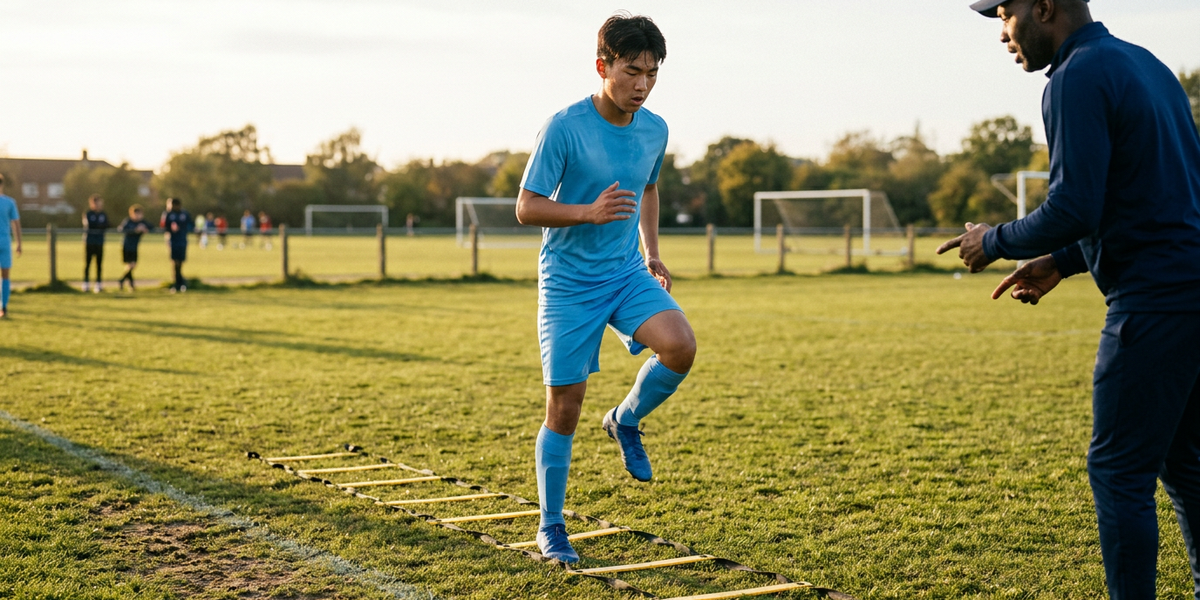
Agility is equally important. Use an agility ladder or simply mark out a ladder on the grass with tape or cones. Move through the ladder with high knees, lateral hops, and in and out steps. The key is to keep your weight on the balls of your feet. After finishing the ladder, immediately enter a 5 yard sprint. Football is a game of transitions, so your body needs to learn how to move from a controlled technical movement into an explosive physical one. If you find yourself getting tired easily, you should learn how to increase your VO2 max to improve your recovery between these sets.
Plyometrics should also be a part of your solo routine to build power. Box jumps, tuck jumps, and single leg hops improve your vertical leap and your first step quickness. Better leg power means you will win more headers and be faster off the mark than your opponent. Incorporate these three times a week at the start of your session when your muscles are fresh. Limit the repetitions but maximize the effort in each jump to ensure you are building explosive white muscle fibers rather than just endurance.
Building an Individual Football Training Plan That Works
An individual training plan should be balanced and progressive. A common error is doing too much of one thing. Your week should be divided into technical days, physical days, and recovery days. For example, Monday could be focused on ball mastery and agility, while Tuesday focuses on shooting and long passing. Wednesday might be a lighter recovery day with stretching and light juggling. By rotating your focus, you prevent mental burnout and reduce the risk of overuse injuries.
Every session should follow a clear structure: a 10 minute dynamic warmup, 20 minutes of high intensity technical work, 20 minutes of position specific drills, 15 minutes of conditioning, and a 5 minute cooldown. Consistency is the most important factor. Training once for four hours is far less effective than training four times for one hour. Your brain and muscles learn best through regular, brief exposures to a skill. Commit to a schedule and stick to it regardless of the weather or your mood.
Tracking your data is a great way to stay motivated. Use a stopwatch to time your sprints and a notebook to record your success rates in passing or shooting drills. When you look back after a month and see that your 40 yard sprint time has dropped or your weak foot accuracy has doubled, it provides a massive confidence boost. This empirical data is also very useful when you are learning <a href="https://footballerscv.com/how-to-make-a-football-cv">how to make a football CV</a>, as it allows you to provide concrete evidence of your physical and technical capabilities to scouts.
How to Practice Football by Yourself Using Video Analysis
In 2026, every player has a high quality camera in their pocket. Recording your solo sessions is one of the most effective ways to improve. When you are training alone, it is easy to think your technique is perfect, but the video often tells a different story. Set up a tripod or lean your phone against a bag and record your shooting or dribbling. Later, compare your form to professional players in your position. Look at your body posture, where your non kicking foot is planted, and your follow through.
Video analysis helps you identify bad habits that might lead to injury or inefficiency. You might notice that you are not fully extending your leg when passing, or that your head is looking down too much while dribbling. Once you see it on screen, it is much easier to correct during your next session. This self coaching approach is common in elite academies across Europe and the USA. It turns you into an independent learner who does not rely solely on a coach for feedback.
Beyond self correction, this footage is extremely valuable for your career. Scouts today are overwhelmed with highlight reels from matches, but they also appreciate seeing a player's work ethic and raw technical ability in a training setting. Clear, edited clips of you performing high level drills can supplement your match highlights. It shows a scout that you are dedicated, disciplined, and possess the fundamental skills required to step into a professional or college environment immediately. Small clips can be easily added to your digital profile.
Mental Resilience and Goal Setting for Unattached Players
Training alone is mentally taxing. The lack of social interaction and immediate competition can make it difficult to stay focused. To combat this, you must set clear, micro goals for every session. Instead of saying you will practice shooting, decide that you will hit the bottom left corner 15 times before you leave the pitch. These small wins release dopamine and keep you engaged. Treat your solo session with the same respect as a cup final at Wembley or a high stakes MLS playoff game.
Visualization is another powerful tool. Before you start a drill, take 30 seconds to visualize yourself performing it perfectly in a match. If you are doing a wall passing drill, imagine you are playing for Manchester City and you are passing to a teammate to break a high press. This mental bridge between the park and the stadium helps maintain your tactical sharpness. It ensures that when you do return to a team, your brain is already accustomed to the speed of thought required at the highest level.
Understand that the grind of solo training is a test of your character. Many players give up when they lose the structure of a club. If you can push yourself through a rainy Tuesday session alone in the park, you are developing a level of mental toughness that will serve you well during professional trials. Most successful professional players have a story about a time they were rejected or unattached and had to find the inner drive to keep going. This period of isolation is where your future success is forged.
The Importance of Documenting Your Solo Progress
In the modern football market, you are a brand as much as a player. Documenting your solo training progress is essential for getting noticed. If you are performing elite level drills, you should be sharing that progress. It proves to prospective coaches that you have been active and healthy. A common question scouts ask about free agents is whether they have stayed sharp. By having a record of your solo sessions, you answer that question before they even ask it.
Your football profile should be a living document of your hard work. This includes your physical stats, your training videos, and your technical milestones. When you apply for a trial or contact a club, having a professional presentation of your individual efforts sets you apart from the thousands of other players who only have grainy match footage from two years ago. It shows a level of professionalism that is highly valued in the modern game, especially in the competitive landscapes of the UK, Europe, and the US college system.
Lastly, remember that solo training is a bridge, not the final destination. The goal is always to get back into a competitive team environment. Use this time to become the best version of yourself so that when your next opportunity comes, you are not just ready, you are the best player on the pitch. Take pride in the work you do when no one is watching, because that is the work that eventually gets noticed under the bright lights of a stadium. Progress is a choice you make every single day you step onto that park alone.
Join the Global Football Community Today
If you are serious about taking your game to the next level during your solo sessions, you need a place to showcase your dedication. FootballersCV is the premier platform for players who want to bridge the gap between training in the park and playing in a professional stadium. By creating a profile, you can upload your training data, highlight your technical skills, and make your details accessible to scouts and clubs worldwide. Do not let your hard work go unnoticed this season. Create your professional football profile today and take the first step toward your next big opportunity.