
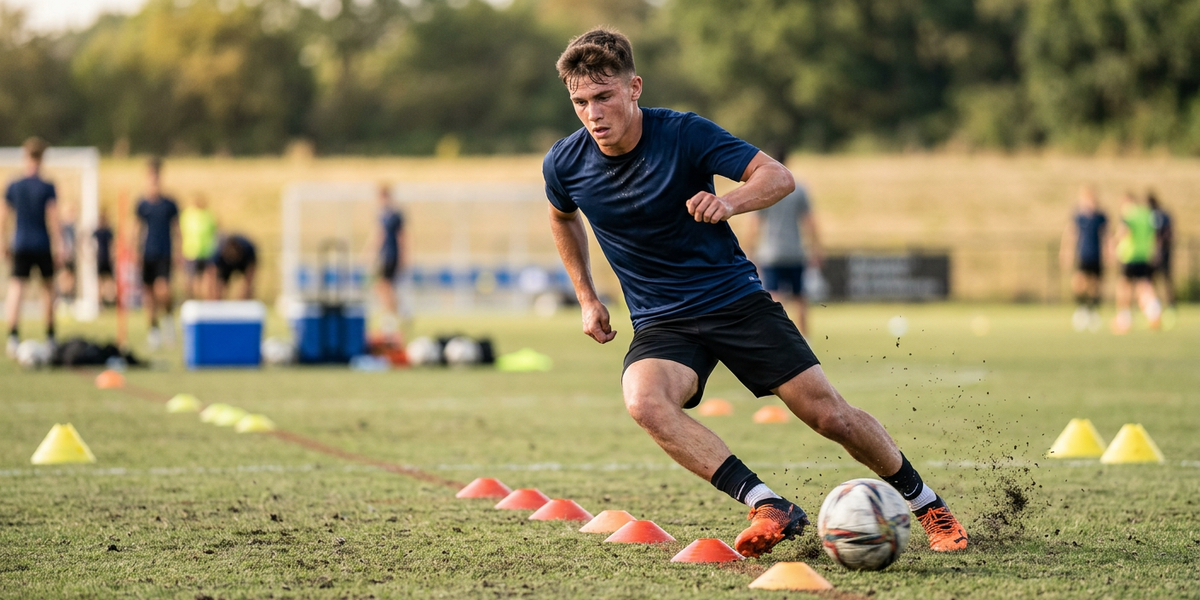
The importance of the 40 metre sprint in modern football
In the current 2026 season, the physical demands of football are higher than they have ever been. While technical skill remains vital, scouts at Category 1 and Category 2 academies in the UK use the 40 metre sprint as a primary benchmark for athletic potential. This distance is critical because it covers both the initial acceleration phase and the transition into top end speed.
If you look at elite wingers or full backs in the Premier League, their ability to cover 40 metres quickly allows them to break lines or recovery tackle effectively. Improving your time by even a fraction of a second can be the difference between winning a 50 50 ball and being left behind. Lowering your sprint time makes you a more attractive prospect for any club looking for explosive talent.
Mastering the mechanics of explosive acceleration
Acceleration is all about your first ten metres. To get faster for football, you must focus on your drive phase where your body is at a 45 degree angle to the ground. Your eyes should be looking down at the turf initially, not up at the finish line, to ensure your center of gravity stays forward.
Powerful arm pumps are just as important as leg drive. Your hands should travel from your hip to your chin in a violent, rhythmic motion. The goal is to apply as much force as possible into the ground with every stride. Avoid taking tiny steps. Instead, focus on big, powerful pushes that propel you forward like a jet taking off from a runway.
Specific drills to improve your top end speed
Once you pass the 20 metre mark, your mechanics shift from a forward lean to an upright posture. This is where top end speed training for footballers becomes essential. Flying 20s are a perfect drill for this. You build up speed for 10 or 20 metres and then hit your absolute maximum velocity for the final 20 metres.
Another effective method is using resistance bands or weighted sleds. Sled pushes and pulls force your muscles to work harder during the acceleration phase. When you remove the weight, your central nervous system is primed to fire faster. This simple contrast training is used by professional clubs like Manchester City and Ajax to develop their youth players.
The role of plyometrics and power in sprinting
Sprinting is essentially a series of horizontal jumps. To lower your 40 metre time, you need to improve how much power your legs can generate in a split second. Plyometric exercises like broad jumps, box jumps, and single leg bounds are non negotiable for ambitious players.
Try incorporating these movements into your routine: Standing broad jumps for explosive power Lateral bounds to improve change of direction speed Depth jumps from a small box to improve ground contact time Single leg hops to build ankle stability and force production These movements teach your tendons to act like springs, returning energy to the ground every time your foot touches the grass.
How to test and track your progress professionally
You cannot improve what you do not measure accurately. In 2026, many academy players use GPS vests or timing gates, but you can get great results with a simple smartphone and a tripod. Use an app that allows for frame by frame analysis to see exactly when your foot clears the start line and when your chest crosses the finish line.
Always test on the same surface, preferably the grass or 4G pitch where you play your matches. Warm up thoroughly for at least 15 minutes before any testing session. Record three sprints with full three minute rest periods between them. This ensures you are testing your maximum capacity rather than your cardiovascular fitness.
Building a weekly speed schedule that works
Speed training requires a fresh nervous system, so you should never do maximal sprints the day after a heavy match or a grueling fitness session. A typical week for a 16 year old player might include two dedicated speed sessions. One session focuses on 0 to 10 metre acceleration, while the second focuses on 30 to 40 metre top speed maintenance.
A sample session looks like this: Ten minute dynamic warmup including leg swings and lunges Three sets of 10 metre wall drills to practice posture Four sets of 20 metre sled pushes with moderate weight Four sets of 40 metre sprints at 100 percent effort Full recovery between every single rep to maintain quality over quantity.
Take the next step with your digital football profile
Improving your speed is only half the battle. Once you have documented your new 40 metre sprint time and have video clips of your explosive pace in matches, you need a way to show that data to the right people. Scouts are constantly looking for verified physical stats to add to their recruitment databases.
Setting up a professional profile allows you to list your physical testing results alongside your match highlights and playing history. By keeping your data updated, you show coaches and scouts that you are a serious athlete who takes player development and physical conditioning seriously. Do not let your hard work in training go unnoticed this season.