
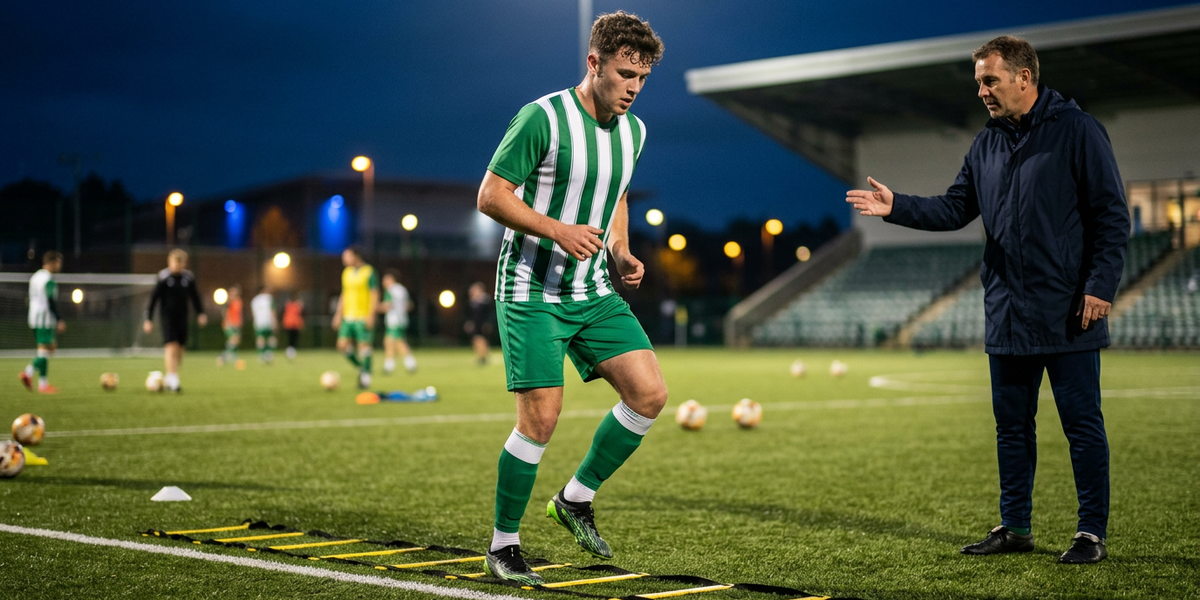
A number 6 in football is the holding midfielder, the player who sits just in front of the back four, protects the defence, wins the ball back and links the defenders to the attacking players. If you have heard a coach say "we need a proper 6", they mean a disciplined central midfielder who holds position, screens passing lanes and keeps the ball moving under pressure.
The number refers to the role, not the shirt. Rodri, Declan Rice, Sergio Busquets and Casemiro have all worn different squad numbers while playing the 6.
What is a number 6 in football?
The number 6 is the deepest midfielder in the team, often called the holding midfielder, defensive midfielder, anchor or pivot. The role comes from the old numbering system where 6 sat between the defenders and the more advanced midfielders.
| Quick facts | Details |
|---|---|
| Common names | Number 6, holding midfielder, defensive midfielder, CDM, anchor, pivot |
| Where they play | Central, just in front of the centre backs |
| Main job | Protect the defence and connect defence to attack |
| Key stats | Interceptions, ball recoveries, pass completion, duels won |
| Typical profile | Calm, tactically intelligent, strong core, excellent first touch |
| Famous examples | Rodri, Declan Rice, Sergio Busquets, Casemiro, N Golo Kante |
In a 4 3 3 the 6 is the single pivot at the base of the midfield triangle. In a 4 2 3 1 there are usually two players sharing the job, called a double pivot, where one holds while the other steps forward.
What position does a number 6 play?
A number 6 plays in central midfield, in the zone between the opposition strikers and their own centre backs. Picture the centre circle and the space just in front of your own penalty area. That corridor is home.
The 6 does move, but always in relation to the ball. Think of yourself as a pendulum. If the ball goes to the left wing, you shift left to offer a passing option and to cover if your winger is beaten. You never drift so far that the middle of the pitch is left open, because that is the most dangerous space on the field for an opponent to occupy.
Two movements define the position. Dropping between or alongside the centre backs to help the team build out from the back, and stepping up to press the opposition number 10. Knowing when to do each is what separates an amateur from a professional.
What does a number 6 do?
In simple terms, a number 6 does four things.
- Protects the defence by covering the space in front of the centre backs.
- Wins the ball back through interceptions, screening and well timed tackles.
- Recycles possession with quick, accurate passing so the team keeps control.
- Organises the players around them with constant communication.
Your success is measured by what does not happen. If your defensive line is rarely exposed and the ball moves smoothly from defence into the creative players, you have had a great game, even without a goal or an assist.
Main responsibilities of a number 6
Screening the back four
Screening is stopping a pass before it is played. A great holding midfielder wins the ball without needing a tackle, simply by standing in the passing lane between the player on the ball and the player trying to receive in the pocket. Standing two yards in front of an opponent can take them out of the game completely, because the passer knows the ball will not get through.
Holding position
Discipline is the job. When the team attacks, you are the insurance policy. It is tempting to join the attack, but if you leave your zone and possession is lost, the counter attack runs straight through where you should have been.
Setting the tempo
You will often have the most touches on the pitch. When your team is under pressure, slow the game with short, safe passes. When the team needs a goal, speed the ball up and look for the forward pass.
Leading
The 6 has the best view of the pitch. Tell your fullbacks when to tuck in, tell the midfielders when to press, and warn the centre backs about runners on their blind side. A quiet number 6 is rarely a successful one.
The number 6 in possession
On the ball, the priority is reliability. A coach would rather see fifty completed 5 yard passes than five ambitious 40 yard passes with two losses.
- Play the way you face. If you win the ball facing your own goal, give it to a centre back or fullback who can see the pitch. If you are facing forward, look for the vertical pass into a striker or a 10.
- Receive on the half turn. Take your first touch out of your feet so you can see the whole field immediately.
- Switch the play. If one side is congested, a two touch sequence through you to the opposite fullback opens the whole game.
- Vary your range. Short passing is your bread and butter, but the ability to clip a diagonal to a winger is a huge asset.
At a professional level, short passing accuracy above 85 percent is the benchmark.
The number 6 out of possession
Defending as a 6 is about space first and the ball second.
- Delay, do not dive in. Step back as the attacker drives forward, knees bent, weight on the balls of your feet, body side on so you can sprint either way.
- Shadow the attacker. Stay between the ball and the player you are marking. Funnel them toward the touchline where the sideline works as an extra defender.
- Read the transition. The moment your team loses the ball is the most dangerous. Decide instantly whether to press the ball carrier or drop and protect the centre backs. If teammates are high up the pitch, keep the play in front of you.
- Win second balls. Long clearances and goal kicks land in your zone. Winning those stops the opposition getting a foothold.
- Use the tactical foul sparingly. A non violent, deliberate foul in the middle third can stop a dangerous break, and coaches respect the intelligence of it, but a yellow card in the first 10 minutes limits your defending for the rest of the game.
Skills needed to be a good number 6
| Skill | Why it matters |
|---|---|
| Positional discipline | Holding your zone prevents counter attacks before they start |
| Scanning | Knowing the picture before the ball arrives buys you time |
| First touch | Functional, not flashy, on either foot |
| Short passing accuracy | Keeps the team in control and the game flowing |
| Reading the game | Interceptions come from anticipation, not speed |
| Communication | You organise the shape in front of and behind you |
| Core and lower body strength | You cannot be knocked off the ball in tight spaces |
| Mobility and stamina | Changing direction quickly matters more than top sprint speed |
| Aerial ability | Second balls and goal kicks arrive in your area |
| Composure | Calm under pressure settles the whole team |
Mobility beats raw pace here. Expect to cover roughly 11 to 13 kilometres in a full match, much of it at a medium jog broken up by short high intensity bursts.
Positioning and tactical awareness
Positioning is the most important skill in the role, and it is built on scanning. Before the ball reaches you, you should already know where three things are: the ball, your teammates and the opposition.
Scouts specifically watch head movement. A midfielder who only watches the ball is treated as a liability at higher levels. Scan every 2 to 3 seconds, even in comfortable possession.
A simple drill: have a partner stand behind you holding up coloured cones or numbers while you wait for a pass. Call out what you see before you touch the ball. It trains your brain to gather information while under physical pressure.
The other half of awareness is spacing. If your centre backs split wide and you drop between them, you create a back three in build up. If your fellow midfielder drifts out of position, you fill the gap temporarily rather than marking the same space as them.
How to play as a number 6
- Start every phase by scanning. Check both shoulders before you receive.
- Take a starting position between the lines. Sit in the shadow of the opposition striker so you are available but hard to mark.
- Show for the ball at an angle. Never stand directly behind an opponent or in a straight line with the passer.
- Play forward first, safe second. Look for the vertical pass, then take the simple option if it is not on.
- Recover position immediately. After every pass, move back into your zone rather than admiring the ball.
- Track the runner, not the ball. When the opposition 8 or 10 breaks forward, go with them.
- Talk the whole game. Short, specific instructions: man on, time, turn, shift right.
- Stay disciplined for 90 minutes. One lapse in concentration in the 88th minute can undo everything.
Number 6 vs number 8
| Number 6 | Number 8 | |
|---|---|---|
| Position | Deepest midfielder | Central midfielder ahead of the 6 |
| Priority | Control and protection | Energy and forward runs |
| Distance covered | High but controlled | Highest in the team |
| Goals and assists | Rare | Expected |
| Risk in passing | Low, keeps possession | Higher, breaks lines |
| Defensive role | Screens the back four | Presses and counter presses |
The short version: the 6 stays, the 8 goes. The 6 is what allows the 8 to attack without leaving the team exposed.
Number 6 vs number 10
| Number 6 | Number 10 | |
|---|---|---|
| Zone | In front of the defence | Between the opposition midfield and defence |
| Job | Stop danger and build play | Create chances and score |
| Facing | Often their own goal | Almost always the opposition goal |
| Measured by | Recoveries, pass completion, shape | Assists, goals, key passes |
They are opposites, and they often mark each other. A big part of your job as a 6 is making sure the opposition 10 never receives the ball facing forward.
Number 6 vs defensive midfielder or CDM
There is no real difference. Number 6, holding midfielder, defensive midfielder, CDM, anchor and pivot all describe the same position, just in different footballing languages. CDM is the term used most in games such as FIFA and EA FC and in American soccer, while number 6 is the more common coaching term in Europe.
The only nuance worth knowing is the difference between a destroyer and a deep lying playmaker. A destroyer wins the ball and gives it simple. A deep lying playmaker dictates the game from deep. The best modern 6 does both.
Famous examples of number 6 style players
- Rodri shows how to control the tempo of a game and never look rushed.
- Sergio Busquets is the reference point for body shape, receiving on the half turn and playing out of tight spaces.
- Declan Rice demonstrates the physical, ball carrying version of the role.
- Casemiro is the example for reading danger and defending the space in front of the centre backs.
- N Golo Kante shows how anticipation and relentless recoveries can define a whole team.
Watch one of them for a full match without following the ball. Watch only their head, their feet and their positioning when the ball is on the far side. That is where the position is really learned.
What scouts look for in a number 6
Standing out as a holding midfielder is difficult because your best work is what you prevent, not what you produce. Scouts know this and they watch you differently.
- They watch you when the ball is on the other side of the pitch. If you are standing still, you fail. If you are adjusting your position and checking your shoulders, you impress.
- They value consistency above highlights. Five games at 7 out of 10 beats one 9 and four 5s.
- They look for communication and organisation, especially during breaks in play.
- They want numbers that fit the role: interceptions, ball recoveries, duels won, pass completion and minutes played, not just tackles.
Learn more in our guides on what scouts look for and how to get scouted and the academy pathway.
Are you a number 6 looking to get noticed?
The hardest part of this position is that a highlight reel of tackles never tells the full story. That is what FootballersCV is for. You can create a free football profile that shows your position, playing history, stats such as interceptions and pass completion, your fitness test results, your video and your contact details, all on one page that clubs, coaches and scouts can view and download.
If you want help with the content itself, read how to make a football CV and the midfielder CV guide.
Tips for young players developing as a number 6
- Master the boring things first. Body shape, first touch and simple passing beat any trick.
- Film yourself from a wide angle. You cannot judge positioning from a close up clip.
- Track your own numbers. Interceptions, recoveries and pass completion give scouts something real to read.
- Practise scanning in every session. It becomes automatic within a few months.
- Learn both pivot roles. Being comfortable as a single 6 and in a double pivot doubles the teams you fit.
- Build your core and single leg strength. Shielding and turning under pressure depend on it.
- Be the loudest organiser on the pitch. Coaches remember it.
- Show your best clips properly. Our highlight video tips explain how to show intercepting, receiving under pressure and switching play, not just tackles.
- Get in front of clubs. Keep an eye on open football trials and apply with a complete profile rather than a message.
The number 6 is a position for the serious student of the game. Coaches and scouts who understand football know that a reliable holding midfielder is one of the hardest players to replace, so play with tactical intent, keep the ball moving, and make sure the right people can see it.